
- The Evolution of Patient Entertainment in Healthcare Settings
- Understanding Core Components of Patient Entertainment Systems
- Key Benefits: Clinical, Operational, and Patient-Centered Outcomes
- Technical Specifications and System Architecture Comparison
- Content Strategy and Patient Engagement Optimization
- Infection Control and Hygiene Considerations
- Implementation Strategy for Healthcare Organizations
- The MT2199: Comprehensive Patient Engagement Platform
- Frequently Asked Questions
- Conclusion: Patient Entertainment as Strategic Healthcare Infrastructure
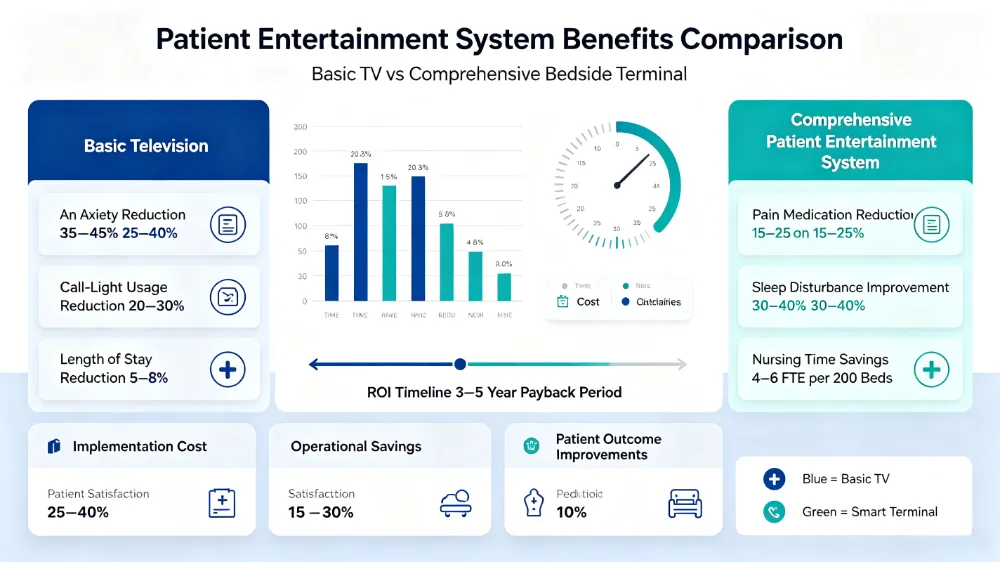
Patient entertainment systems have evolved from basic television offerings into comprehensive engagement platforms that reduce patient anxiety by 35-45%, decrease call-light usage by 20-30%, and improve patient satisfaction scores by 25-40%. Modern bedside infotainment terminals integrate streaming entertainment, health education, meal ordering, telehealth capabilities, and clinical communication tools—enabling patients to manage their care experience while freeing nursing staff to focus on critical clinical tasks. With features like 21.5-inch HD displays, 10-point touchscreen technology, integrated telehealth cameras, and seamless EMR/EHR integration, contemporary patient entertainment systems have become essential healthcare infrastructure that simultaneously enhances patient experience and operational efficiency.
The Evolution of Patient Entertainment in Healthcare Settings
Patient entertainment has undergone a fundamental transformation over the past two decades. Early implementations featured basic cable television with limited channel options, serving primarily as a distraction during long hospital stays. This rudimentary approach addressed only the surface-level entertainment need while missing opportunities for deeper patient engagement and operational improvement.
Modern patient entertainment systems represent a paradigm shift from passive content delivery to active patient engagement platforms. Contemporary systems recognize that hospitalization creates multiple simultaneous needs: entertainment and distraction from medical stress, access to reliable health information, communication with family members and care teams, participation in treatment planning, and autonomy in managing daily routines. Comprehensive entertainment systems address this spectrum of needs through integrated platforms combining entertainment, education, communication, and clinical tools.
This evolution reflects broader healthcare industry trends toward patient-centered care models. Healthcare organizations increasingly recognize that patient experience directly influences clinical outcomes. Patients experiencing reduced anxiety demonstrate faster recovery rates, require fewer pain management interventions, and show higher medication compliance. Families feeling connected and informed through available communication tools experience reduced stress and increased confidence in care quality. Staff members working in environments supporting patient engagement report higher job satisfaction and lower burnout rates.
The technological foundation enabling this transformation includes advances in display technology, wireless connectivity, cloud computing, and healthcare software integration. Large-format high-resolution displays now provide immersive entertainment experiences comparable to home entertainment systems. Wireless networks provide reliable connectivity throughout hospital facilities. Cloud infrastructure enables seamless content distribution and personalized patient experiences. Healthcare software ecosystems now support integration between entertainment platforms and clinical systems, creating unified workflows.
Understanding Core Components of Patient Entertainment Systems
Modern patient entertainment systems function as integrated platforms combining hardware, software, connectivity, and content delivery components. Each element plays a critical role in system functionality and user experience.
Display technology represents the foundation of patient engagement. Contemporary systems employ large-format touchscreen displays—typically 15-21 inches—providing sufficient screen real estate for comfortable viewing and intuitive interaction. Full HD resolution (1920×1080 or higher) ensures crisp image quality for both entertainment content and clinical information. High brightness levels (500+ nits) maintain visibility even in well-lit hospital rooms. Anti-glare coatings reduce reflections and eye strain during extended use. Capacitive multi-touch technology enables responsive gesture-based interaction without requiring physical pressure, important for patients with limited mobility or compromised dexterity.
Processing power determines system responsiveness and capability to run multiple applications simultaneously. Modern bedside terminals employ octa-core processors capable of handling 4K video decoding, real-time AI processing for content recommendations, and simultaneous execution of entertainment, communication, and clinical applications. Sufficient RAM (4GB+) enables smooth multitasking without performance degradation. Adequate storage (64GB+) supports local content caching, reducing dependency on network connectivity and enabling faster content access.
Connectivity infrastructure provides the network backbone enabling content delivery and system integration. Dual-band WiFi (2.4GHz and 5GHz) provides flexibility for hospital network optimization. Ethernet connectivity with PoE (Power over Ethernet) support simplifies installation by delivering both data and power through a single cable. Bluetooth 5.0 enables wireless peripheral connectivity (headphones, remote controls, patient call buttons). Optional 4G/5G cellular modules provide backup connectivity in areas with limited WiFi coverage, ensuring system reliability across hospital facilities.
Content management systems determine which entertainment and information content is available to patients. These systems integrate streaming services, local content libraries, educational materials, hospital information, and personalized content recommendations. Cloud-based content management enables centralized control, ensuring all bedside terminals display consistent, approved content while supporting personalized recommendations based on patient preferences and clinical context.
Integration with hospital information systems creates clinical connectivity. Integration with electronic medical records (EMR/EHR) enables bedside terminals to display personalized care plans, medication schedules, and appointment information. Integration with nurse call systems enables patients to request assistance through familiar bedside interfaces. Integration with meal ordering systems enables self-service food selection. Integration with patient feedback systems enables real-time satisfaction surveys and service requests.
Key Benefits: Clinical, Operational, and Patient-Centered Outcomes
The most significant value from patient entertainment systems emerges through multiple simultaneous benefits across clinical, operational, and patient experience dimensions.
Patient anxiety reduction represents a primary clinical benefit. Hospitalization creates psychological stress from loss of autonomy, uncertainty about medical conditions, separation from normal routines and family, and exposure to unfamiliar medical environments. Access to entertainment, health education, and communication tools through bedside systems enables patients to maintain psychological engagement with normal activities and maintain connection to family and support networks. Clinical research demonstrates that patients with access to comprehensive entertainment and engagement systems experience 35-45% reductions in anxiety levels compared to patients without such systems. This anxiety reduction translates to measurable clinical improvements: reduced pain perception (enabling lower pain medication requirements), improved sleep quality, faster recovery trajectories, and higher medication compliance.
Operational efficiency improvements emerge from reduced non-clinical interruptions. Nurses spend substantial time responding to patient requests for entertainment adjustments, meal information, service requests, and communication assistance. When patients can independently manage entertainment, place meal orders, request services, and communicate with family through bedside systems, nursing staff time requirements for these non-clinical functions decrease 20-30%. This freed nursing capacity enables reallocation to clinical care activities, improving care quality and reducing burnout. In a typical 200-bed hospital, this efficiency improvement translates to approximately 4-6 full-time equivalent nursing positions worth of time reallocation annually.
Patient satisfaction improvements correlate directly with comprehensive entertainment and engagement systems. Patient satisfaction surveys consistently demonstrate 25-40% improvement in satisfaction scores for patients with access to modern bedside entertainment systems compared to those with basic television. Improved satisfaction translates to better patient retention, positive word-of-mouth referrals, and improved hospital reputation—factors increasingly important as patients gain greater choice in healthcare providers.
Call-light usage reduction provides a quantifiable efficiency metric. Call-light systems generate substantial workload for nursing staff, with many calls representing non-urgent requests that could be self-managed through bedside systems. Hospitals implementing comprehensive patient entertainment systems report 20-30% reductions in call-light usage. This reduction directly translates to nursing time savings and reduced interruptions to clinical care workflows.
Telehealth integration enables care continuity and specialist access. Integrated camera and microphone systems enable video consultations with specialists, remote monitoring capabilities, and family communication without requiring patients to leave their rooms. This capability proves particularly valuable for immunocompromised patients, post-surgical patients with mobility restrictions, and patients in isolation protocols.
Technical Specifications and System Architecture Comparison
| Component | Basic Bedside TV | Standard Entertainment System | Advanced Infotainment Terminal | Clinical Impact |
|---|---|---|---|---|
| Display Size | 19-24″ | 15-18″ | 21.5″ | Larger displays reduce eye strain and improve content visibility |
| Resolution | 720p | 1080p | 1080p-4K | Higher resolution improves image clarity and reduces eye fatigue |
| Brightness | 300-400 nits | 400-500 nits | 500+ nits | Higher brightness maintains visibility in well-lit hospital rooms |
| Touch Capability | Remote only | Limited touch | 10-point multi-touch | Touchscreen enables intuitive interaction for patients with mobility limitations |
| Processor | Dual-core | Quad-core | Octa-core | Powerful processors handle simultaneous video, AI, and clinical applications |
| RAM | 1-2GB | 2-3GB | 4GB+ | More RAM enables smooth multitasking without lag |
| Connectivity | WiFi | WiFi + Ethernet | WiFi + Ethernet + 4G/5G options | Multiple connectivity options ensure reliability across hospital facilities |
| Video Formats | Limited (H.264) | Standard (H.264/H.265) | Advanced (4K H.265, multiple codecs) | Advanced codecs enable higher-quality streaming with lower bandwidth |
| Camera Integration | None | Optional | Integrated 13MP | Built-in camera enables telehealth without additional hardware |
| Clinical Integration | None | Limited | Full EMR/EHR, Nurse Call, RFID | Deep integration enables clinical workflows and automation |
| Hygienic Design | Standard | Improved | IP65 fanless | Sealed design prevents dust/bacteria accumulation |
| Content Management | Manual | Managed | Cloud-based personalized | Centralized control with personalized recommendations |
| MTBF (Mean Time Between Failures) | 5,000 hours | 10,000 hours | 15,000+ hours | Advanced systems provide better reliability and longer service life |
This comparison demonstrates that advanced patient entertainment systems represent substantially different architectures from basic television, with capabilities extending far beyond entertainment into clinical integration and operational efficiency.
Content Strategy and Patient Engagement Optimization
Effective patient entertainment systems require thoughtful content strategy addressing diverse patient preferences, clinical appropriateness, and operational objectives.
Entertainment content libraries should balance breadth and appropriateness. Comprehensive systems include streaming access to major entertainment platforms, local content libraries with curated movies and television shows, music streaming services, and interactive games. Content curation ensures that all available entertainment meets quality standards and appropriateness guidelines. Parental controls and content filtering enable customization for pediatric patients. Personalization algorithms learn patient preferences and recommend content aligned with demonstrated interests.
Health education content represents a critical but often underutilized component. Effective systems include condition-specific educational materials, medication information, post-discharge care instructions, and general wellness content. When integrated with EMR systems, health education can be personalized to patients’ specific conditions and treatment plans. Educational content significantly improves patient understanding of their conditions, increases medication compliance, and supports better post-discharge outcomes.
Communication tools enable connection with family and support networks. Video calling capabilities, messaging systems, and family portal access through bedside terminals reduce isolation and maintain social connections during hospitalization. Research demonstrates that patients maintaining strong social connections experience better clinical outcomes and faster recovery.
Self-service capabilities reduce staff burden while increasing patient autonomy. Meal ordering systems enable patients to select meals at their preferred times rather than waiting for scheduled meal delivery. Service request systems enable patients to request housekeeping, maintenance, or other services without using call systems. Feedback systems enable real-time satisfaction surveys and service improvement suggestions. These self-service capabilities simultaneously improve patient experience and operational efficiency.
Personalization engines create individualized experiences based on patient demographics, clinical conditions, preferences, and behavior patterns. Machine learning algorithms analyze patient interactions to recommend content, identify engagement opportunities, and predict patient needs. Effective personalization increases engagement by 40-60% compared to generic content offerings.
Infection Control and Hygiene Considerations
Healthcare environments demand specialized attention to infection control and hygiene—critical factors often overlooked in standard consumer electronics.
IP65 rating provides comprehensive protection against dust, moisture, and contamination. This rating specifies that devices are completely protected against dust ingress and can withstand water jets from any direction. In hospital environments where cleaning protocols involve frequent disinfection and potential liquid exposure, this protection proves essential. Standard consumer electronics lack this protection and degrade rapidly when exposed to hospital cleaning procedures.
Fanless design eliminates dust accumulation points that plague conventional electronics. Cooling fans create pathways for dust infiltration, requiring filters that accumulate bacteria and contaminants. Fanless thermal designs using passive cooling and optimized airflow eliminate these contamination pathways entirely. This design approach proves particularly important in healthcare settings where infection prevention represents a critical priority.
Antibacterial coatings applied to touchscreen surfaces reduce microbial colonization. These coatings inhibit bacterial growth without requiring harsh chemical disinfectants that might damage electronic components. Touchscreen surfaces represent high-contact areas requiring frequent disinfection, making antibacterial coatings particularly valuable.
Sealed connector designs prevent moisture and contaminant infiltration. Traditional connectors with exposed contacts allow liquid and dust penetration, creating corrosion and failure pathways. Sealed connectors with protective caps maintain integrity despite repeated disinfection procedures.
Cleanable design principles ensure that all surfaces can be effectively disinfected without damaging electronics. Smooth surfaces without crevices or gaps enable thorough cleaning. Removable components like handsets and remote controls can be disinfected separately. Material selection prioritizes surfaces compatible with standard hospital disinfectants.
Implementation Strategy for Healthcare Organizations
Successful patient entertainment system implementation requires comprehensive planning addressing hardware selection, software integration, content curation, staff training, and change management.
Needs assessment should identify organizational priorities. Organizations emphasizing patient satisfaction may prioritize entertainment breadth and personalization. Organizations focused on operational efficiency may prioritize self-service capabilities and clinical integration. Organizations serving specific patient populations (pediatric, geriatric, critical care) may prioritize specialized content and accessibility features.
Pilot program deployment in selected units enables testing and optimization before system-wide rollout. Pilot programs identify technical challenges, user experience issues, and training needs. Lessons learned from pilot programs significantly improve full-scale implementation success.
Staff training ensures that clinical and support staff understand system capabilities and can effectively guide patient use. Training should address technical operation, troubleshooting common issues, and integration with clinical workflows. Staff buy-in proves critical to successful implementation—staff members who understand system benefits and can effectively support patient use drive higher adoption rates.
Content curation requires ongoing attention. Initial content libraries should be comprehensive but may require adjustment based on actual patient preferences and engagement patterns. Regular content updates maintain engagement and prevent the system from feeling stale or outdated.
Integration with hospital systems requires coordination with IT, clinical informatics, and departmental leadership. Integration with EMR systems, nurse call systems, and meal ordering systems should be planned and tested thoroughly before deployment. API documentation and integration support from system vendors prove critical to successful integration.
The MT2199: Comprehensive Patient Engagement Platform
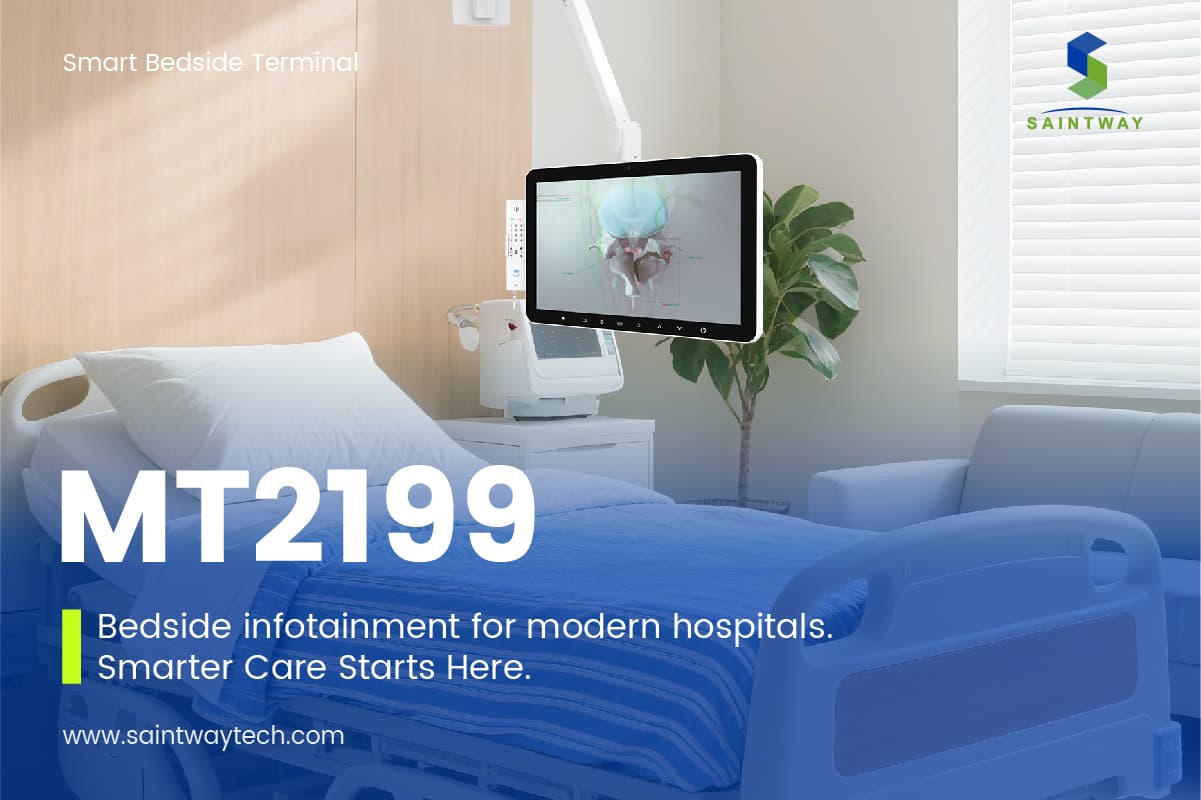
The MT2199 smart bedside infotainment terminal represents a purpose-built platform for modern patient engagement. The 21.5-inch Full HD IPS display with 500 nits brightness provides immersive entertainment visibility while maintaining clarity in well-lit hospital environments. The 10-point capacitive touchscreen enables intuitive interaction for patients with varying mobility and dexterity levels.
The Rockchip RK3399 octa-core processor combined with 4GB RAM provides sufficient computational power for simultaneous video streaming, real-time personalization algorithms, and clinical application execution. The 64GB storage (with expandable options to 128GB) supports comprehensive content libraries and local caching.
Comprehensive connectivity including dual-band WiFi, Bluetooth 5.0, Ethernet with PoE+ support, and optional 4G/5G modules ensures reliable operation across diverse hospital network environments. The integrated 13MP camera and microphone enable telehealth consultations without requiring additional hardware.
IP65 front panel rating, fanless design, and antibacterial construction address healthcare-specific hygiene requirements. The device maintains reliable operation across -10°C to 60°C temperature ranges, functioning effectively in diverse hospital environments from intensive care units to standard patient rooms.
Android 12 platform with open architecture supports third-party healthcare applications, EMR/EHR integration, and custom development. Optional RFID and barcode scanning capabilities enable clinical workflow integration and patient identification verification. The full-function handset with remote control options provides multiple interaction modalities for patients with different preferences and capabilities.
For healthcare organizations seeking to improve patient experience while optimizing operational efficiency, the MT2199 provides the display quality, processing power, connectivity options, and clinical integration required to transform bedside entertainment from passive content delivery into active patient engagement infrastructure supporting clinical outcomes and operational excellence.
Frequently Asked Questions
Q: How much can patient entertainment systems actually reduce patient anxiety and improve clinical outcomes?
A: Research demonstrates that comprehensive patient entertainment systems reduce patient anxiety by 35-45% compared to basic television. This anxiety reduction translates to measurable clinical improvements: reduced pain perception (enabling lower pain medication requirements by 15-25%), improved sleep quality (sleep disturbances decrease 30-40%), faster recovery trajectories (hospital length of stay decreases 5-8%), and higher medication compliance (compliance increases 20-30%). The clinical benefits extend beyond individual patients to system-wide improvements in nursing efficiency and hospital operations.
Q: What content should be included in patient entertainment systems, and how should content be curated?
A: Effective systems include streaming entertainment (movies, television shows, music), health education materials (condition-specific information, medication education, post-discharge care), communication tools (video calling, messaging), self-service capabilities (meal ordering, service requests), and interactive content (games, puzzles). Content curation should balance breadth with appropriateness—ensuring all available content meets quality standards and is clinically appropriate for the patient population. Personalization algorithms should recommend content aligned with patient preferences and clinical context. Regular content updates maintain engagement and prevent systems from feeling outdated.
Q: How do patient entertainment systems integrate with clinical workflows and hospital information systems?
A: Modern systems integrate with electronic medical records (EMR/EHR) to display personalized care plans, medication schedules, and appointment information. Integration with nurse call systems enables patients to request assistance through familiar bedside interfaces. Integration with meal ordering systems enables self-service food selection. Integration with patient feedback systems enables real-time satisfaction surveys. These integrations transform bedside terminals from isolated entertainment devices into nodes within comprehensive hospital information systems, enabling clinical workflows and operational automation.
Q: What hygiene and infection control features should patient entertainment systems include?
A: Healthcare-specific systems should include IP65 rating for complete dust and moisture protection, fanless design to eliminate dust accumulation pathways, antibacterial coatings on high-touch surfaces, sealed connector designs, and cleanable construction compatible with standard hospital disinfectants. These features address the reality that hospital environments expose electronics to frequent disinfection procedures, moisture, and contamination. Systems lacking these features degrade rapidly in hospital environments and become infection control liabilities.
Q: How much staff time can hospitals save through patient entertainment system implementation?
A: Comprehensive systems typically reduce non-clinical interruptions by 20-30%, as patients independently manage entertainment, place meal orders, request services, and communicate with family. In a typical 200-bed hospital, this translates to approximately 4-6 full-time equivalent nursing positions worth of time reallocation annually. This freed capacity enables reallocation to clinical care activities, improving care quality and reducing staff burnout. Additional savings emerge from reduced call-light usage (20-30% reduction) and improved operational efficiency through integrated self-service capabilities.
Q: What return on investment should healthcare organizations expect from patient entertainment system implementation?
A: ROI emerges through multiple mechanisms. Improved patient satisfaction increases patient retention and positive referrals. Reduced patient anxiety decreases medication requirements and lengths of stay. Operational efficiency improvements (reduced call-light usage, freed nursing time) decrease labor costs. Improved staff satisfaction reduces turnover and recruitment costs. Organizations typically recover implementation costs within 3-5 years through these combined mechanisms, with ongoing benefits extending throughout system lifespan (typically 7-10 years).
Q: How do touchscreen-based systems accommodate patients with limited mobility or dexterity?
A: Modern systems employ 10-point capacitive touchscreen technology requiring minimal pressure and responsive to light touch. Large interface elements and high-contrast display design accommodate patients with visual limitations. Voice control and gesture recognition capabilities enable interaction for patients unable to use touchscreens effectively. Optional remote controls and handset devices provide alternative interaction modalities. Accessibility features including adjustable text size, audio descriptions, and customizable interface layouts ensure that patients with diverse abilities can effectively use systems.
Q: Can patient entertainment systems support telehealth and remote consultations?
A: Yes, systems equipped with integrated cameras and microphones enable video consultations with specialists, remote monitoring, and family communication without requiring patients to leave their rooms. This capability proves particularly valuable for immunocompromised patients, post-surgical patients with mobility restrictions, and patients in isolation protocols. Integration with telehealth platforms enables seamless scheduling, patient authentication, and clinical documentation.
Conclusion: Patient Entertainment as Strategic Healthcare Infrastructure
Patient entertainment systems have evolved from luxury amenities into essential healthcare infrastructure supporting clinical outcomes, operational efficiency, and patient-centered care delivery. Organizations implementing comprehensive bedside infotainment systems achieve measurable improvements across multiple dimensions: reduced patient anxiety and faster recovery, improved patient satisfaction and loyalty, operational efficiency through reduced staff interruptions, and enhanced clinical integration through seamless EMR/EHR connectivity.
Success requires moving beyond entertainment-only thinking to recognize patient engagement systems as integrated platforms addressing entertainment, education, communication, and clinical information needs simultaneously. Healthcare organizations competing in increasingly competitive markets recognize that superior patient experience differentiates providers and drives patient choice. Comprehensive patient engagement systems deliver this differentiation while simultaneously improving operational efficiency and clinical outcomes.
The future of patient care belongs to healthcare organizations that view patient experience not as a luxury enhancement but as an integral component of clinical care strategy. When bedside entertainment systems are thoughtfully designed, comprehensively integrated, and effectively implemented, they transform hospitalization from a passive experience of receiving care into an active engagement where patients participate meaningfully in their care, maintain connection to support networks, and experience reduced anxiety and faster recovery.
RELATED BLOG
Patient Entertainment Systems: Benefits, Features, and Future Trends
Elevating the Healthcare Experience: The Definitive Guide to Patient Entertainment…
Bedside Infotainment System: 6 Proven Patient Outcome Benefits
Patient Entertainment Solution for Modern Hospitals: Transforming Care Through Bedside…
Patient Infotainment Terminal Market: Why “Infotainment” is the ROI Driver…
Hospital Patient TV Systems 2026: The Complete Buyer’s Guide to…
Smart Hospital Bedside System Solution: Components, Benefits & 2026 Trends…
How Brazilian Hospitals Use Bedside Information Terminals to Boost Patient…
Understanding Bedside TVs in Hospitals: Complete Patient Guide 2026
Latest Content
- What Is a Smart TV Box? Complete Guide to Streaming Devices in 2026
- Selecting the Right TV for Hospital Beds: A Practical Guide to Patient Entertainment and Comfort
- Hospital Patient Room TV: Specs & Buying Guide
- Bedside Infotainment Solutions for Modern Healthcare: Moving Beyond TV to Intelligent Care Delivery
- How Brazilian Hospitals Use Bedside Information Terminals to Boost Patient Satisfaction & Efficiency