
- What Is a Bedside Terminal?
- How Bedside Terminals Work
- Key Features and Functions
- Types of Bedside Terminals
- Benefits for Patients
- Benefits for Hospitals and Clinicians
- Bedside Terminal vs. Traditional Nurse Call Systems
- Market Size, Growth, and Regional Trends
- Top Bedside Terminal Manufacturers
- Implementation Guide
- Integration with Hospital Systems
- Cost Analysis and ROI
- Challenges and Limitations
- The Future of Bedside Terminals
- Frequently Asked Questions
- Conclusion
The global bedside terminal market is projected to reach $2.8 billion by 2030, growing at a CAGR of 8.4%, as hospitals worldwide accelerate digital transformation. Yet most published guides on the topic are thin, outdated, or vendor-biased. This guide is different: it’s a comprehensive, vendor-neutral resource that covers everything you need to know about bedside terminals — from clinical workflows to ROI calculations.
What Is a Bedside Terminal?
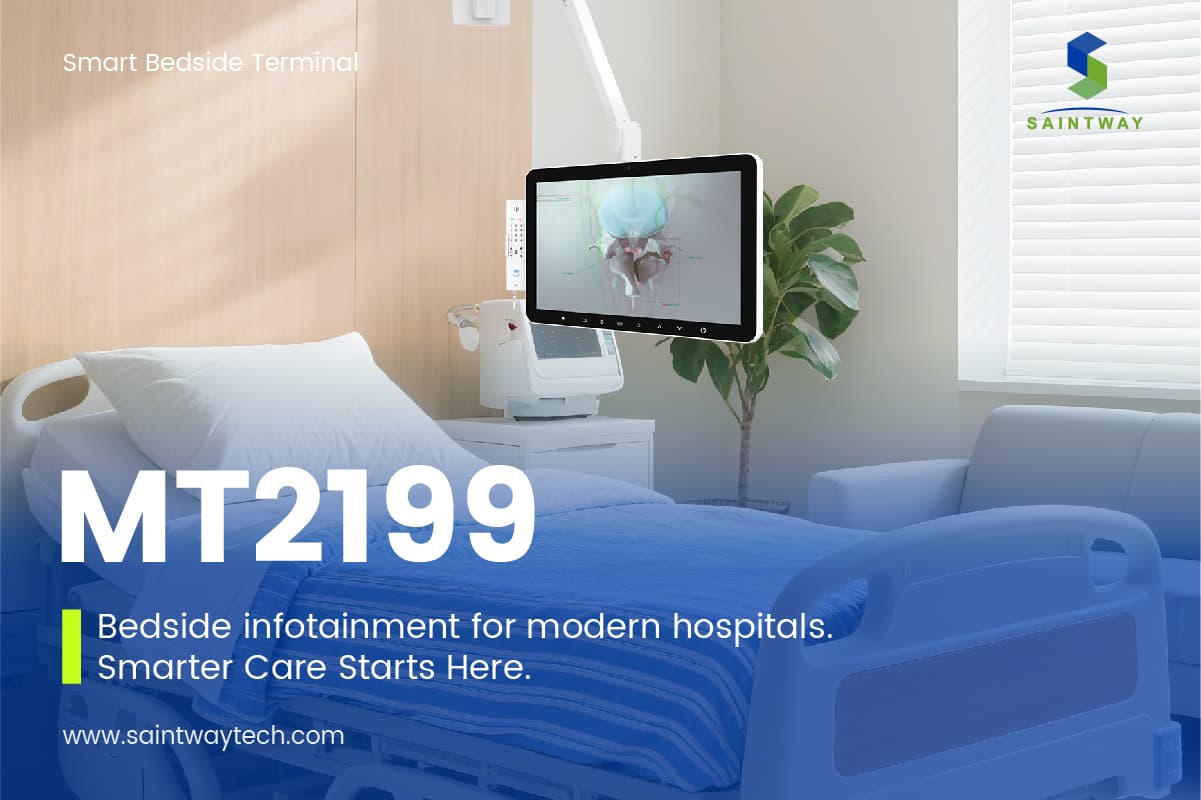
A bedside terminal is a multimedia, interactive device — typically a touchscreen tablet, all-in-one PC, or smart monitor — mounted at a patient’s hospital bed to deliver entertainment, communication, education, and clinical services. It acts as a single point of access for patients, clinicians, and hospital staff to interact with hospital information systems, entertainment platforms, and care-related applications.
Modern bedside terminals are far more than glorified TVs. They function as:
- Patient engagement platforms for education, meal ordering, and feedback
- Clinical workflow tools for nurses, doctors, and allied health staff
- Communication hubs for video calls, telehealth, and visitor management
- Data collection endpoints for vitals, satisfaction surveys, and room controls
The term “bedside terminal” is sometimes used interchangeably with patient bedside terminal, in-room patient terminal, bedside infotainment terminal, or bedside entertainment system. For the purposes of this guide, all refer to the same class of hospital-grade device.
How Bedside Terminals Work
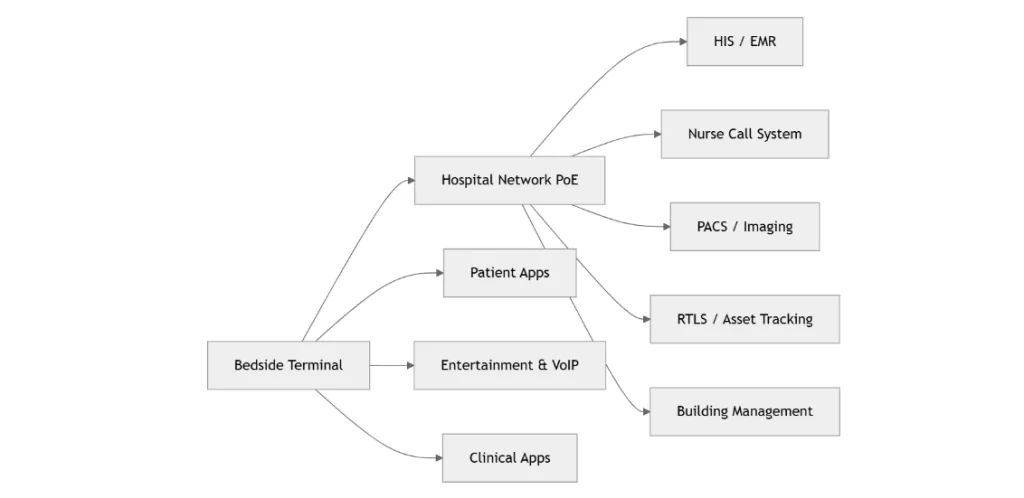
At a technical level, bedside terminals are compact, fanless computers running a specialized operating system (often Android, Linux, or a hardened Windows IoT variant). They connect to the hospital’s network infrastructure — typically via Power over Ethernet (PoE) for both data and power — and integrate with core hospital platforms:
The terminal’s software stack usually consists of three layers:
- Device layer — hardware drivers, anti-microbial touchscreens, RFID/NFC readers, and barcode scanners
- Middleware layer — device management (MDM), single sign-on, and HL7/FHIR gateways
- Application layer — patient-facing apps (meals, education, entertainment) and clinician-facing apps (charting, eMAR, vitals)
Key Features and Functions
Today’s bedside terminals bundle an increasingly wide feature set. The most competitive platforms include:
Patient-Facing Features
- HD entertainment — live TV, radio, on-demand movies, streaming apps
- Internet access — controlled web browsing, social media, email
- Communication — VoIP phone, video calls with family, telehealth sessions
- Education — condition-specific video libraries, medication explanations, discharge instructions
- Self-service — meal ordering, room service, lighting and blind control
- Feedback — HCAHPS surveys, real-time satisfaction reporting
- Language localization — multi-language support for diverse patient populations
Clinician-Facing Features
- EMR access at the point of care
- Barcode medication administration (BCMA) and electronic medication administration record (eMAR)
- Vitals capture via Bluetooth-connected devices
- Clinical decision support with alerts and reminders
- Secure messaging between care team members
- Telepresence and remote consultation
Hardware Features
- Anti-microbial, IP65-rated housings to withstand hospital cleaning protocols
- Multi-touch capacitive displays (typically 15″ to 24″)
- Built-in camera, microphone, and speakers for video calls
- RFID, NFC, and smart card readers for staff authentication
- Privacy mode that disables cameras/microphones when not in use
- Adjustable articulating arms for patient comfort and ergonomics
Types of Bedside Terminals
Bedside terminals come in several form factors, each suited to different hospital environments.
| Type | Best For | Pros | Cons |
|---|---|---|---|
| Wall-mounted (fixed) | Long-stay inpatient rooms | Secure, always powered, integrated | Limited adjustability |
| Arm-mounted (articulated) | General medical-surgical units | Flexible viewing angles, swivels to clinician or patient | Higher cost, mechanical wear |
| Tablet on dock | Ambulatory care, rehab | Portable, lower cost | Battery management, theft risk |
| Hybrid (detachable) | Mixed-use wards | Versatile | Heavier, more complex |
| Bed-rail mounted | Space-constrained rooms | Saves space, lightweight | Smaller screen, less stable |
Pro tip: When evaluating form factors, consider the average length of stay in each unit, patient acuity, and ergonomic guidelines from your ergonomics or occupational health team.
Benefits for Patients
Patient experience is no longer a “soft” metric — it directly affects HCAHPS scores, reimbursement, and hospital reputation. Bedside terminals measurably improve the patient experience in several ways:
- Reduced anxiety and boredom — Entertainment and communication help patients cope with long stays.
- Better health literacy — On-demand educational content improves comprehension of diagnoses and discharge instructions.
- Increased sense of control — Self-service features (room temperature, meals, lighting) restore autonomy.
- Stronger connection to family — Video calls reduce isolation, particularly in ICUs and for elderly patients.
- Faster discharge — Patients who view digital discharge instructions are 30% more likely to adhere to post-acute care plans (source: Journal of Hospital Medicine, 2022).
- Inclusive care — Multi-language support and accessibility features (text-to-speech, high-contrast mode) improve equity.
Benefits for Hospitals and Clinicians
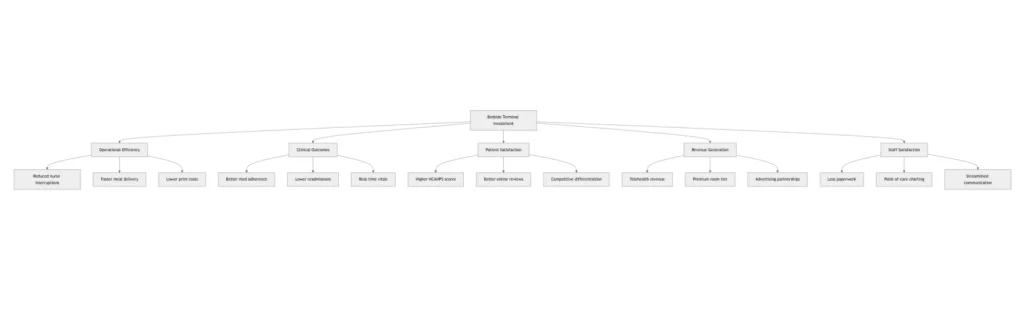
For hospital leadership, the case for bedside terminals rests on five pillars:
Quantified Benefits (Industry Studies)
- 22% reduction in patient call button usage after deploying interactive bedside terminals (HIMSS case study, 2023)
- 15–25 minutes saved per shift per nurse from reduced documentation time
- 4–7 point lift in HCAHPS “Communication About Medicines” scores
- $1.2M average annual savings in a 300-bed hospital from reduced paper, printing, and film costs
- 18% drop in 30-day readmission rates for heart failure patients using bedside education modules
Bedside Terminal vs. Traditional Nurse Call Systems
A common question from hospital IT teams is: Can a bedside terminal replace our nurse call system? The short answer is yes — but only if properly integrated.
| Capability | Traditional Nurse Call | Bedside Terminal |
|---|---|---|
| Patient-to-nurse call | ✅ | ✅ |
| Two-way voice | ✅ | ✅ |
| Pain scale input | ❌ | ✅ |
| Service requests (towels, food) | ❌ | ✅ |
| Real-time staff location | ⚠️ Limited | ✅ (via RTLS integration) |
| Patient education | ❌ | ✅ |
| Entertainment | ❌ | ✅ |
| Clinical charting | ❌ | ✅ |
| Cost | Low | Medium–High |
The best deployments use the bedside terminal as a unified communication and engagement platform, with the nurse call system as a certified medical device providing life-safety backup.
Market Size, Growth, and Regional Trends
The bedside terminal market is one of the fastest-growing segments in healthcare IT hardware.
By the Numbers
- 2024 market size: ~$1.6 billion
- 2030 projected: $2.8 billion (CAGR 8.4%)
- Largest region: North America (~42% share)
- Fastest-growing region: Asia-Pacific (CAGR 11.2%)
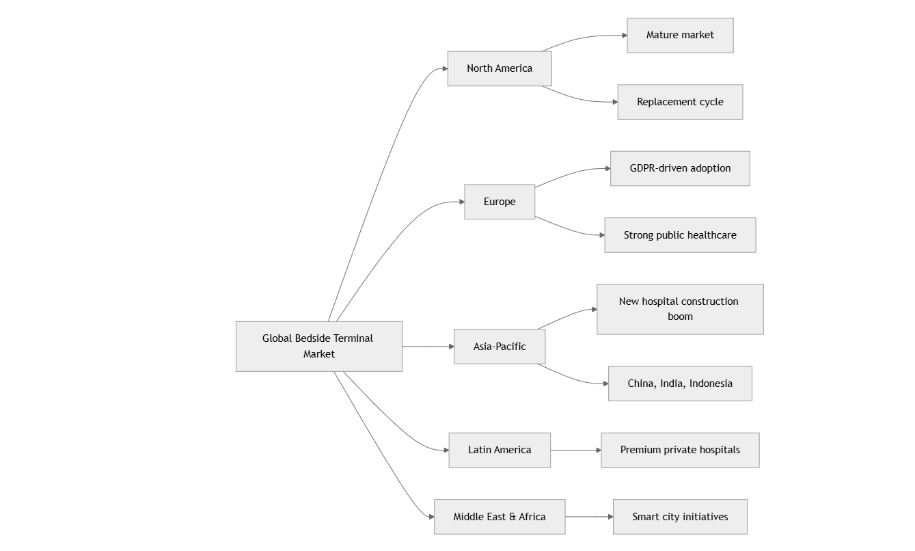
Regional Adoption Patterns
Key Growth Drivers
- Patient experience mandates from CMS, NHS, and other regulators
- Smart hospital construction in emerging markets
- Telehealth normalization post-COVID
- Hospital digital transformation budgets
- Nurse staffing shortages driving automation
Top Bedside Terminal Manufacturers
The vendor landscape is fragmented but consolidating. Here are the most prominent players as of 2026:
| Manufacturer | Headquarters | Notable Strength |
|---|---|---|
| BEWATEC | Germany | European reference deployments, modular design |
| Barco | Belgium | Medical-grade displays, strong imaging integration |
| Advantech | Taiwan | Wide hardware portfolio, OEM partnerships |
| Avalue Technology | Taiwan | Fanless, medical-certified systems |
| Onyx Healthcare | Taiwan | Custom OEM/ODM bedside solutions |
| Pdi Communication | USA | Patient engagement software leader |
| Curbell Medical | USA | Nurse call and patient entertainment integration |
| Arbor Technology | Taiwan | Compact medical PCs |
| TEGUAR | USA | Industrial medical computing |
| Saintway | China | Fanless, medical-certified systems |
Selection tip: Always validate that the vendor is IEC 60601-1 medically certified and offers FDA-cleared or CE-marked components where required.
Implementation Guide
A bedside terminal deployment is a multi-year, multi-stakeholder program. Here’s a proven 7-phase methodology:
Phase 1: Discovery (Months 1–2)
- Stakeholder mapping (clinical, IT, facilities, finance, patient experience)
- Current state assessment of nurse call, EMR, and entertainment
- Patient and clinician interviews
- KPI definition
Phase 2: Vendor Selection (Months 2–4)
- RFI/RFP process
- Reference site visits
- Cybersecurity review
- Total cost of ownership (TCO) modeling
Phase 3: Design (Months 4–6)
- Network readiness (PoE switches, VLAN design, Wi-Fi coverage)
- Power and cabling infrastructure
- Mounting and ergonomics review
- Integration architecture (HL7, FHIR, REST APIs)
Phase 4: Pilot (Months 6–8)
- Single-unit deployment in one room
- Clinical workflow validation
- Patient feedback collection
- Iterative refinement
Phase 5: Rollout (Months 8–18)
- Phased by unit/floor
- Just-in-time training
- Hypercare support
- Continuous improvement
Phase 6: Optimization (Months 18+)
- Usage analytics review
- Software updates
- New feature rollout
- Expansion to new use cases
Phase 7: Expansion
- Outpatient areas
- ED, ICU, NICU specialized configurations
- Telehealth integration
Integration with Hospital Systems
A bedside terminal’s value multiplies when integrated with existing hospital systems. Common integrations include:
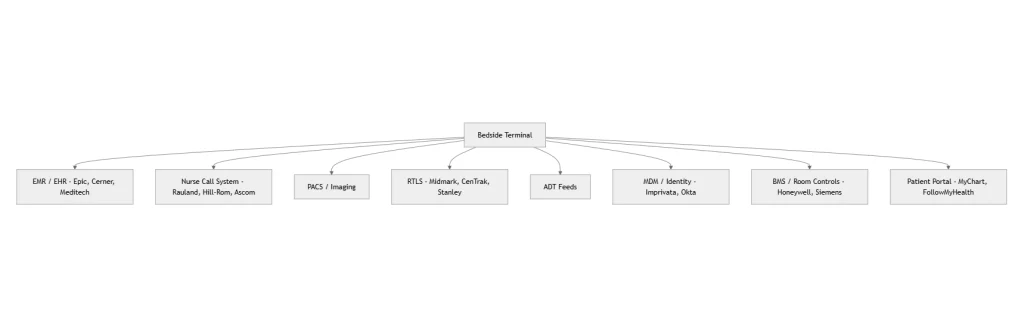
Key Integration Standards
- HL7 v2.x for legacy messaging
- FHIR R4/R5 for modern API integration
- DICOM for imaging review
- IHE PCD for device data
- SIP/VoIP for nurse call and telephony
Cost Analysis and ROI
Typical Per-Bed Cost
| Component | Cost Range (USD) |
|---|---|
| Hardware (terminal, mount, PoE) | $2,500 – $6,000 |
| Software licenses (perpetual or SaaS) | $500 – $1,500/yr |
| Installation & cabling | $800 – $1,500 |
| Training | $200 – $400 |
| Total Year 1 per bed | $4,000 – $9,400 |
ROI Drivers
- Reduced readmissions — $15K+ per avoided 30-day readmission
- Higher HCAHPS → higher CMS reimbursement — up to $500K/year for a 300-bed hospital
- Print and supply savings — $200K–$400K annually
- Nurse productivity — equivalent of 2–3 FTE per 100 beds
- Telehealth revenue capture — $1M+ annually for mid-size hospitals
Most well-implemented projects achieve payback in 24–36 months.
Challenges and Limitations
No technology is without tradeoffs. Be aware of:
- Cybersecurity risk — endpoints expand the attack surface; require strong MDM, network segmentation, and patching
- Patient hygiene — terminals must withstand aggressive disinfectants; choose IP65-rated, anti-microbial housings
- Training fatigue — staff turnover means continuous training investment
- Capital constraints — upfront cost can be a barrier for smaller hospitals
- Workflow disruption — poorly designed UI can frustrate clinicians
- Accessibility — must support elderly, disabled, and non-English-speaking patients
The Future of Bedside Terminals
The bedside terminal is evolving rapidly. Watch for these trends through 2026–2030:
- AI-powered personalization — content and education tailored to patient profile
- Voice-first interfaces — reducing touch in infection-sensitive environments
- Ambient intelligence — terminals that respond to room context (e.g., “lights off” or “nurse”)
- Wearable integration — continuous vitals streamed to terminal display
- Digital therapeutics (DTx) — delivering FDA-cleared therapeutic content at the bedside
- Generative AI assistants — patient-facing chatbots for FAQ and discharge education
- Blockchain consent management — granular control over who accesses patient data via the terminal
- Sustainability focus — recyclable materials, lower-power ARM-based designs
- Convergence with smart home tech — Matter/Thread for room controls
- Personal device mirroring — secure casting from patient phones for entertainment
Frequently Asked Questions
What is a bedside terminal?
A bedside terminal is a hospital-grade interactive device mounted near a patient’s bed, providing entertainment, communication, education, and access to clinical systems for both patients and care teams.
How much does a bedside terminal cost?
Costs range from $2,500 to $6,000 per bed for hardware, plus software, installation, and training. Total first-year cost is typically $4,000–$9,400 per bed.
What is the bedside terminal market size?
The global market was valued at approximately $1.6 billion in 2024 and is projected to reach $2.8 billion by 2030.
Who are the leading bedside terminal manufacturers?
Major manufacturers include BEWATEC, Barco, Advantech, Onyx Healthcare, Avalue, and Pdi Communication.
What is the difference between a bedside terminal and a nurse call system?
A nurse call system is a safety-critical device for summoning help. A bedside terminal is a broader engagement and clinical tool that can include nurse call functions but also delivers entertainment, education, and EMR access.
Are bedside terminals secure?
When properly deployed with network segmentation, MDM, encryption, and patching, bedside terminals meet HIPAA and GDPR requirements. Security must be designed in from day one.
Can patients use their own devices instead?
BYOD (bring your own device) is complementary but not a replacement. Hospital-owned terminals ensure equitable access, clinical-grade reliability, and infection control.
What integrations are most important?
EMR, nurse call, ADT, and identity management are essential. RTLS, PACS, and BMS are high-value additions.
How long does deployment take?
A typical hospital-wide deployment takes 12–24 months from kickoff to full rollout, depending on bed count and integration complexity.
Conclusion
Bedside terminals have evolved from luxury amenities into strategic clinical infrastructure. When thoughtfully selected, integrated, and deployed, they improve patient experience, support overburdened clinical staff, and deliver measurable financial returns.
The key to success is treating the bedside terminal not as a device purchase, but as a multi-year digital transformation program — with executive sponsorship, clinical champions, robust integration, and continuous optimization.
Hospitals that get this right will outperform their peers on patient experience scores, staff retention, and operational efficiency. Those that treat it as a simple hardware refresh will leave value on the table.
About This Guide
This article is independently researched and regularly updated. For citations, vendor comparisons, or to request a specific deep-dive, contact our healthcare IT editorial team. Last updated: September 2026.
Latest Content
- What Is a Smart TV Box? Complete Guide to Streaming Devices in 2026
- Selecting the Right TV for Hospital Beds: A Practical Guide to Patient Entertainment and Comfort
- Hospital Patient Room TV: Specs & Buying Guide
- Consumer vs Medical-Grade Tablets in Healthcare: Why Compliance Matters
- Bedside Infotainment System: 6 Proven Patient Outcome Benefits