
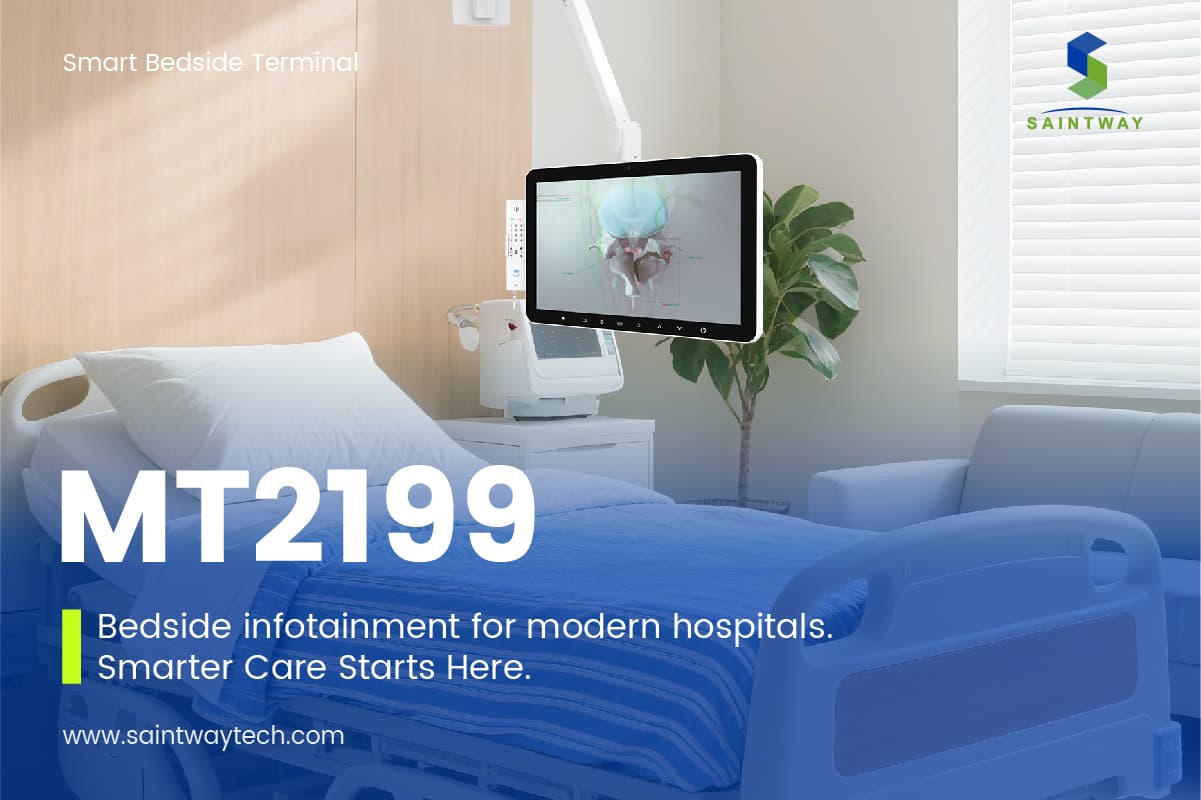
In the post-pandemic healthcare landscape, hospital wards have evolved from mere treatment spaces into critical hubs for patient recovery and psychological support. For hospital administrators, the challenge is twofold: balancing patient satisfaction with operational efficiency and strict compliance. The nodes connecting these goals are the intelligent terminals embedded at the bedside.
This article explores how to build a modern Medical Devices Supply Chain Strategy, dissecting the technical evolution from basic Hospital TV units to advanced Bedside Terminals. Furthermore, it analyzes the pivotal role of specialized Touch Screen Manufacturers in optimizing the Bio Medical Supply Chain Strategy, providing a practical framework for healthcare institutions and integrators to implement reliable digital solutions.
I. The Macro Perspective: Shifting Paradigms in Supply Chain
Historically, medical information silos were a significant barrier, with hardware devices often viewed as one-time capital expenditures rather than ongoing system nodes. However, with the proliferation of the Internet of Medical Things (IoMT), this perception is fundamentally changing.
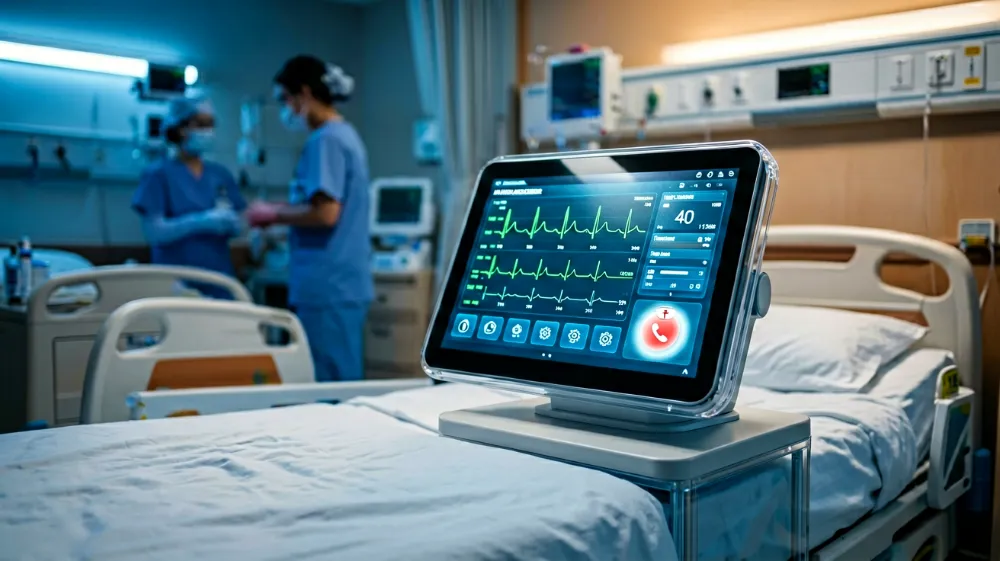
A mature Medical Devices Supply Chain Strategy no longer focuses solely on the turnover of critical pharmaceuticals. It must encompass all digital terminals that directly interact with patients or clinical environments. When display screens become the gateway for medical data flow, the stability of their supply chain directly dictates system availability. For instance, if Hospital TV Systems suffer frequent outages due to screen module failures, it not only degrades the patient experience but may also delay response times for emergency call functions.
Consequently, building a robust Bio Medical Supply Chain Strategy has become a key differentiator for industry leaders. This strategy requires upstream manufacturers to meet higher compliance standards. In the Patient Infotainment Terminal Market, suppliers must do more than just provide entertainment content; they must deliver a hardware foundation that meets stringent biosafety standards. This means every link in the supply chain—from raw material traceability to final installation calibration—must adhere to medical-grade certifications to ensure long-term safety and reliability.
II. Scenario Segmentation: From “Watching TV” to “Smart Interaction”
In modern hospital layouts, terminal devices are not uniform; they are stratified based on usage depth and interaction complexity. Understanding these segments is a prerequisite for optimizing procurement strategies.
1. The Basic Tier: Patient Entertainment Systems & Hospital TV
For most general wards, the core requirement remains content consumption. Traditional Hospital TV units are being upgraded into more professional Patient Entertainment Systems.
- Functional Evolution: Simple playback is no longer sufficient. Modern systems integrate Video on Demand (VOD), notification displays, and self-service call functions.
- Hardware Form Factor: To save space and prevent physical damage, many hospitals choose to embed screens into bedside cabinets or walls. This design imposes strict requirements on Hospital TV Systems, necessitating waterproof, dust-proof, and easy-to-clean housing designs.
2. The Advanced Tier: Bedside Terminals & Medical Touch Screens
When the need shifts from “watching” to “interacting,” the Bedside Terminal emerges. This is the intelligent upgrade of traditional Patient TV Systems and represents the frontier of Healthcare Touch Screen technology implementation.
A high-quality Medical Touch Screen is not just an input device; it is part of the medical safety perimeter. Unlike consumer-grade touchscreens, Healthcare Touch Screen units must pass rigorous biocompatibility tests. Their surface materials must withstand high-frequency disinfection wiping and possess an exceptionally long lifespan. For example, patients may use a Bedside Terminal to self-check-in, view daily bills, adjust room lighting, or call a nurse. This high-frequency touch operation demands screens with rapid response times and superior durability.
In the overall architecture of Patient TV Systems, the Bedside Terminal serves as the core node, often connecting to central servers via wired or wireless methods. For suppliers, the ability to provide a full-stack solution—from a single screen to a complete interactive Patient TV System—is the decisive factor in capturing market share.
III. Technical Core: Manufacturing Capability and Compliance Barriers
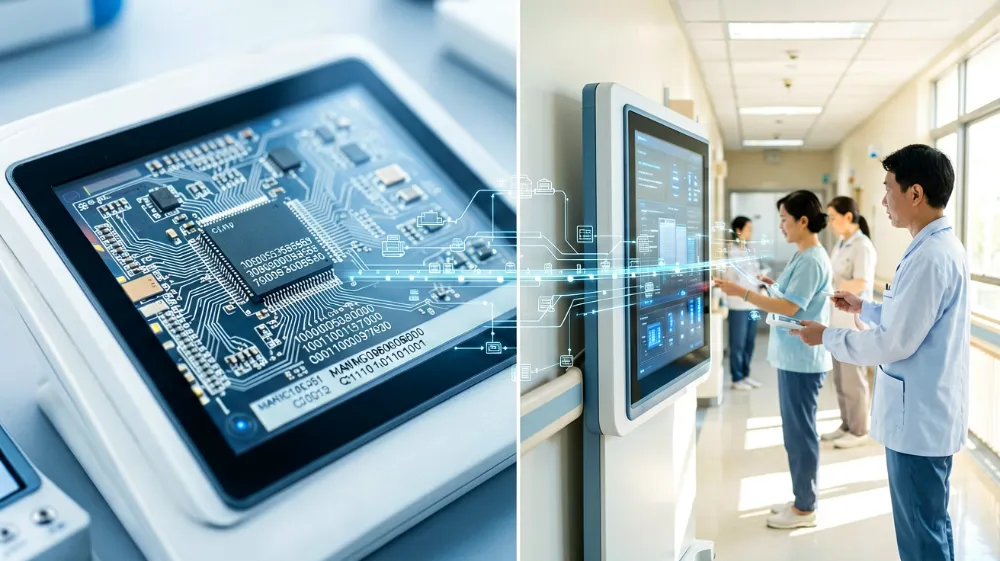
Creating stable terminal devices like these hinges on the underlying display and touch technology. Many integrators, when seeking Touch Screen Manufacturers, fall into the trap of prioritizing low cost over quality, ignoring the fundamental differences between Healthcare Touch Screen and civilian Touch Screen technology.
1. Medical-Grade vs. Consumer-Grade Differences
As a professional Touch Screen Manufacturer, we understand that a Medical Touch Screen is far more than glass and circuit boards. It involves several critical indicators:
- Disinfection Resistance: The screen coating must withstand repeated contact with corrosive liquids such as chlorine-based disinfectants and alcohol without degrading.
- Electromagnetic Compatibility (EMC): Hospital environments are filled with electromagnetic interference from various medical devices. Healthcare Touch Screen units must have strong anti-interference capabilities to prevent false touches or signal loss.
- Traceability: Every Medical Touch Screen module must have a unique serial number to facilitate quick localization and replacement during failures, a key component of Bio Medical Supply Chain Strategy compliance.
2. Optimizing the Supplier Ecosystem
The market is crowded with Touch Screen Manufacturers, but not all possess medical-grade production credentials. Leading integrators tend to establish deep bindings with partners who have vertical integration capabilities.
- Single Source vs. Multi-Sourcing: To ensure supply continuity, many large hospital groups adopt a multi-source strategy but require all Touch Screen Manufacturers to adhere to unified quality standards.
- Custom Development: For different tiers of Bedside Terminals, screen size, brightness (which must adapt to the dim lighting of wards), and interface protocols (such as RS485, IPK, RS232) all require customization. This level of customization demands that a Touch Screen Manufacturer possesses rapid R&D response speed, not just the capability of a contract factory.
IV. Implementation: Building an End-to-End Digital Loop
Translating these concepts into tangible value requires a complete execution strategy. Below are implementation recommendations based on a Medical Devices Supply Chain Strategy:
1. Standardize Interfaces to Reduce Maintenance Costs
When deploying Hospital Patient TV Systems, it is recommended to unify backend communication protocols. For example, whether the frontend is a simple Hospital TV or a complex Bedside Terminal, the backend should support standard medical data interaction protocols. This not only reduces development costs but also smooths out future upgrades and replacements. When hardware needs to be swapped, one only needs to ensure the new Healthcare Touch Screen module is interface-compatible, avoiding the need to reconstruct the entire system.
2. Full Lifecycle Management
A true Bio Medical Supply Chain Strategy covers the entire device lifecycle—from compliance review at procurement, to environmental adaptation during installation, to remote monitoring during operation, and finally eco-friendly recycling at disposal.
- Remote Diagnostics: Advanced Patient TV Systems feature remote health check capabilities. If a Bedside Terminal’s Medical Touch Screen shows latency or sensitivity issues, the system can automatically raise an alarm. This preventive maintenance significantly reduces sudden failure rates and enhances patient satisfaction.
- Spare Parts Strategy: Since Touch Screen Manufacturers have long production lead times, hospitals are advised to maintain reasonable spare parts inventory. For high-volume common models, localized assembly or pre-tested spare parts can be considered to ensure high availability of Hospital TV Systems.
3. User Training and Experience Optimization
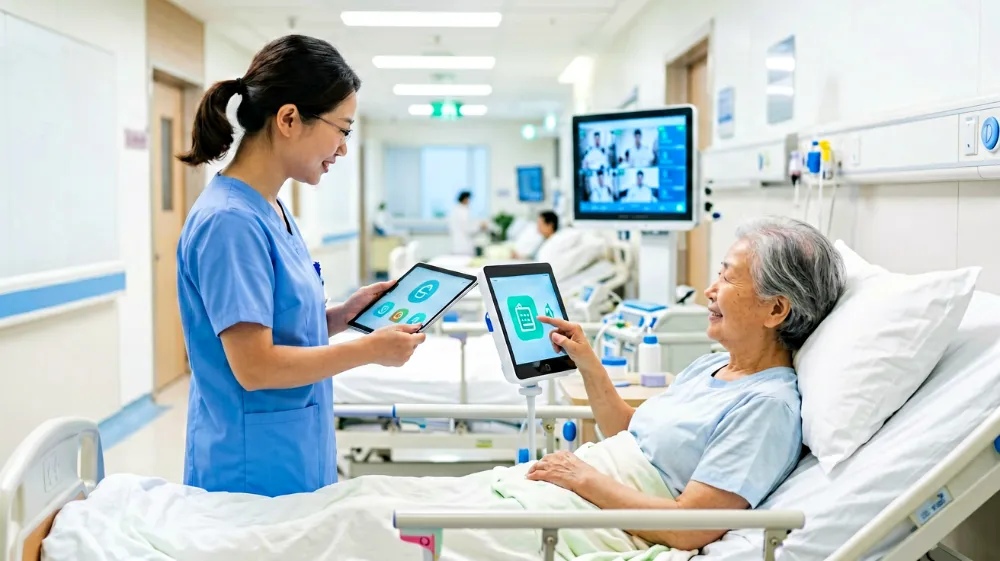
Hardware is merely the carrier; experience is the goal. When introducing new products into the Patient Infotainment Terminal Market, clear interface guides must accompany them. For Bedside Terminals, the interface design should feature large fonts, high contrast, and simplified operation flows to accommodate patients of all age groups. Simultaneously, healthcare workers should receive quick training to assist patients immediately when technical issues arise, preventing technology barriers from affecting the doctor-patient relationship.
V. Conclusion: Toward Smarter Wards
In summary, modern medical informatization is no longer limited to software system construction; the intelligence of hardware terminals and the refinement of the supply chain are equally vital. From the macro level of Medical Devices Supply Chain Strategy to the micro level of Medical Touch Screen manufacturing, every link is tightly interconnected.
For hospital administrators, when choosing between Hospital TV Systems or Bedside Terminals, the focus should not be solely on the initial procurement price. Instead, one must comprehensively evaluate the long-term operational value of the Patient Entertainment System, the durability of the Healthcare Touch Screen, and the service capability of the Touch Screen Manufacturer. By building a robust Bio Medical Supply Chain Strategy, hospitals can not only improve the stability of Patient TV Systems but also set a benchmark in the Patient Infotainment Terminal Market, creating a truly safe, comfortable, and efficient recovery environment for patients.
The ward of the future will be a smart space where data flows smoothly and interaction is natural and seamless. This transformation begins with a single, qualified Medical Touch Screen.
Latest Content
- Bedside Terminal: The Complete Guide to Patient-Centric Hospital Technology
- How Patient Entertainment Systems Improve Hospital Outcomes & Reduce Healthcare Costs | 2026 Guide
- 21.5-Inch Bedside Medical Infotainment Display: Complete Hospital Guide 2026
- Integrated Bedside Infotainment: 2026 Implementation & Security Guide
- Patient Entertainment Systems: Benefits, Features, and Future Trends