
- What Makes a 21.5-Inch Bedside Medical Infotainment Display Essential for Patient Care and Hospital Operations?
- All-in-One Medical Point-of-Care Terminal
- Fanless Medical Infotainment Terminal
- Medical Terminal with MSR and Smart Card Reader
- IP65 Rated Bedside Healthcare Terminal
- Medical Grade Terminal with Nurse Call Integration
- Medical Terminal with Modular Mounting System
- Healthcare Facility Implementation Considerations
- Frequently Asked Questions
What Makes a 21.5-Inch Bedside Medical Infotainment Display Essential for Patient Care and Hospital Operations?
A 21.5-inch bedside medical infotainment display combines patient entertainment, clinical information access, and operational efficiency in a single device. This screen size balances visibility for patients and healthcare providers while fitting practical bedside space constraints. Modern implementations include fanless design for infection control, IP65 rating for washdown compatibility, integrated nurse call systems, and smart card readers for secure access. These terminals reduce hardware footprint, lower total cost of ownership, and improve patient satisfaction while maintaining HIPAA compliance and clinical-grade durability standards.
All-in-One Medical Point-of-Care Terminal
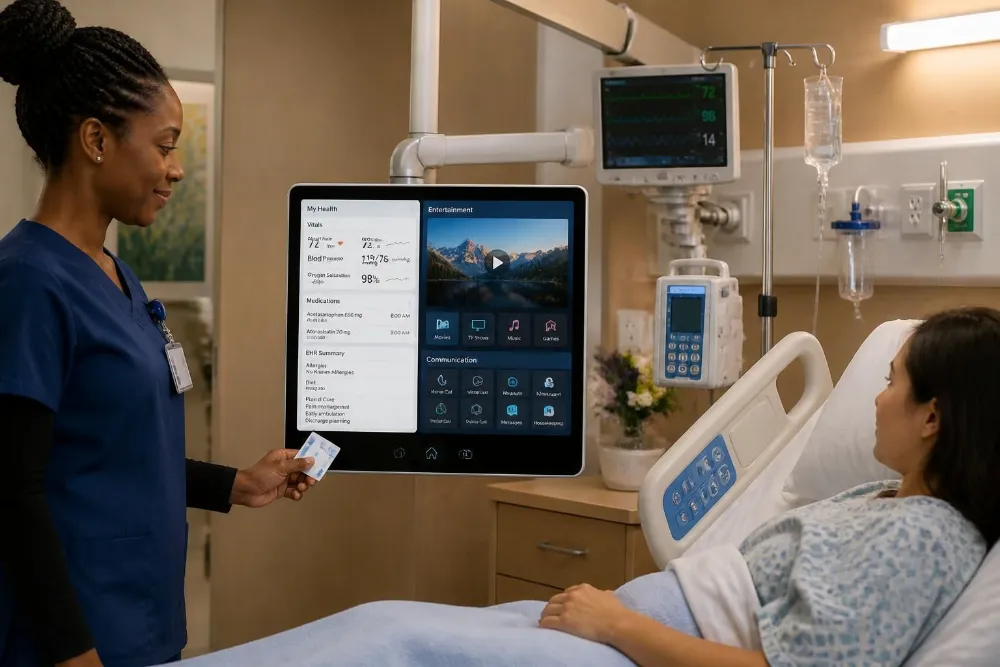
Integrated bedside terminals consolidate multiple clinical functions into a single device, reducing equipment clutter, simplifying workflows, and improving infection control compliance.
Healthcare facilities traditionally deployed separate devices for patient entertainment, clinical monitoring, nurse communication, and administrative access. This fragmentation created operational complexity, increased infection risk through multiple touchpoints, and consumed valuable bedside real estate. A 21.5-inch all-in-one terminal transforms this landscape by consolidating these functions into a unified platform.
The all-in-one approach delivers substantial operational advantages. Nurses access electronic health records, medication administration systems, and patient monitoring data from a single authenticated device. Patients simultaneously enjoy entertainment, educational content, and meal ordering through a separate user interface. Clinical staff spend less time managing multiple devices and more time providing patient care. The unified architecture reduces power consumption, simplifies IT management, and minimizes the surface area requiring regular disinfection.
Integration extends to communication systems. Bedside terminals function as communication hubs, enabling patients to request assistance, adjust room temperature, or contact family members through a single interface. Simultaneously, clinical staff receive alerts, view patient status information, and access decision-support tools. This bidirectional communication reduces unnecessary trips to patient rooms, improves response times to patient requests, and enhances overall care coordination.
From an infection control perspective, consolidation significantly reduces risk vectors. Each additional device in a patient room represents additional surfaces requiring disinfection and additional potential contamination sources. A single large-screen terminal with integrated controls reduces disinfection burden while maintaining or improving functional capability. Healthcare-associated infection prevention benefits directly from this reduction in equipment complexity.
Fanless Medical Infotainment Terminal
Fanless design eliminates mechanical failure points, reduces maintenance requirements, and improves infection control by removing dust-accumulation pathways.
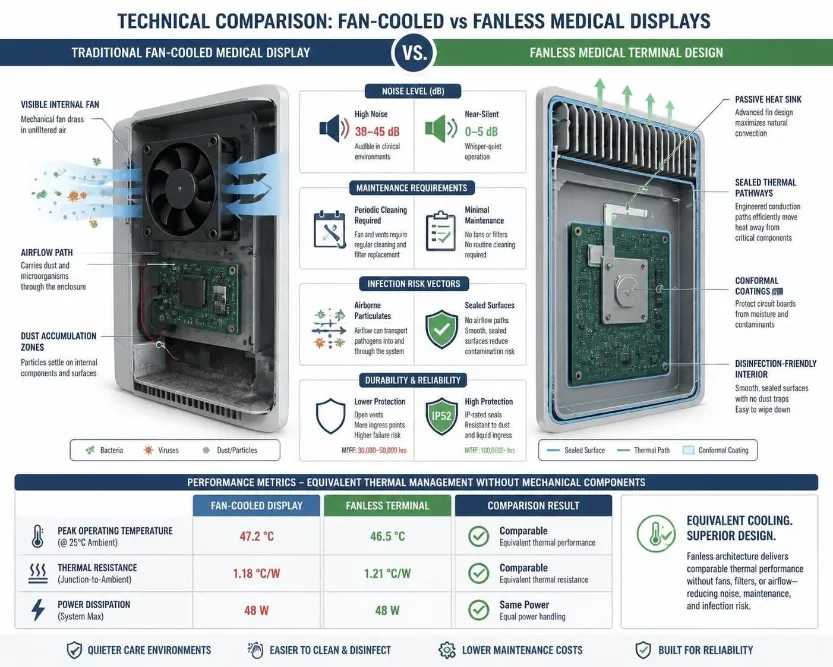
Traditional medical displays rely on active cooling systems with fans to manage thermal loads. While functional, these fans create operational challenges in healthcare environments. Moving mechanical components accumulate dust, harbor microorganisms, and require regular maintenance. Fans generate noise that disturbs patient rest and creates acoustic stress in patient care environments. Most critically, fan failure can compromise device functionality precisely when clinical information access becomes essential.
Fanless thermal management uses passive cooling through optimized heat sink design, advanced materials, and intelligent power management. Modern processors and components generate substantially less heat than predecessors, enabling fanless operation without thermal throttling or performance compromise. A 21.5-inch bedside terminal with fanless design maintains full computational capability while eliminating the maintenance burden and infection control risks associated with mechanical cooling.
The infection control advantages extend beyond mechanical considerations. Fanless designs eliminate air circulation patterns that can spread airborne pathogens within patient rooms. The sealed thermal architecture prevents dust and biological particles from accumulating within the device. Healthcare facilities report reduced device-related infections and improved compliance with environmental infection control protocols when deploying fanless bedside terminals.
Operational benefits compound over device lifespan. Fanless terminals require no preventive maintenance for cooling systems. Healthcare IT departments eliminate fan replacement costs, reduce service calls, and simplify inventory management. Facilities deploying hundreds of bedside terminals across multiple units experience substantial cost savings through reduced maintenance overhead. The reliability improvement translates to fewer clinical disruptions and reduced downtime incidents.
Medical Terminal with MSR and Smart Card Reader
Integrated card readers enable secure clinical authentication, medication verification, and patient identification without requiring separate peripheral devices.
Healthcare workflows depend on secure authentication and data verification at multiple touchpoints. Clinicians must verify their identity before accessing patient records. Medications require verification through barcode scanning before administration. Patients require identification confirmation before treatment. Traditional approaches deployed separate magnetic stripe readers, barcode scanners, and smart card readers—creating equipment clutter and workflow fragmentation.
A 21.5-inch terminal with integrated magnetic stripe reader (MSR) and smart card reader consolidates these verification functions. Clinicians swipe their credentials to authenticate and access role-based clinical systems. Medication barcodes are scanned for verification before administration, directly integrating with pharmacy systems and reducing medication errors. Patient identification cards are read to confirm correct patient matching before procedures or treatments. This integration streamlines workflows while maintaining rigorous security and safety standards.
The smart card integration particularly enhances security compliance. Healthcare providers increasingly implement smart card authentication for HIPAA compliance and clinical data protection. Bedside terminals with integrated smart card readers enable secure access without requiring external readers that create cable management challenges and potential contamination vectors. Clinicians authenticate directly at the point of care, accessing only information appropriate to their role and current patient assignment.
Medication verification through integrated scanning significantly reduces adverse events. Studies demonstrate that barcode-verified medication administration reduces wrong-drug errors by 86% and wrong-dose errors by 60%. When bedside terminals incorporate barcode scanning, verification becomes seamlessly integrated into clinical workflow rather than an additional step. Nurses scan medications at the bedside, the system confirms correct patient, correct medication, and correct dose before administration is logged, creating a comprehensive safety net.
IP65 Rated Bedside Healthcare Terminal
IP65 rating ensures device durability against washdown procedures, spill incidents, and aggressive disinfection protocols essential in modern healthcare environments.
Hospital bedside environments expose equipment to moisture, cleaning solutions, and disinfectants. Traditional consumer or office-grade displays fail rapidly in these conditions. Liquid ingress damages internal components, creates electrical hazards, and compromises patient safety. Healthcare facilities require displays specifically engineered to withstand the chemical and moisture exposure inherent to clinical environments.
IP65 rating indicates complete dust protection and water jet resistance from any direction. A 21.5-inch terminal rated IP65 withstands direct spray from washdown hoses during terminal cleaning procedures. Healthcare facilities can safely apply approved disinfectants, including alcohol-based solutions and quaternary ammonium compounds, without risking device damage. This capability directly supports infection prevention protocols requiring thorough environmental disinfection between patient occupancies.
The practical implications extend beyond simple disinfection. IP65-rated terminals survive accidental spills—water, coffee, medications, bodily fluids—without damage. In patient care environments, such incidents occur regularly. A standard display would require replacement; an IP65-rated device continues functioning after cleaning. This resilience reduces equipment downtime, lowers replacement costs, and ensures continuous access to clinical information and patient communication capabilities.
Durability advantages compound across device lifespan. A bedside terminal rated IP65 survives 5-7 years of continuous exposure to moisture, disinfectants, and aggressive cleaning. Standard displays typically fail within 2-3 years under identical conditions. The extended operational lifespan translates to lower total cost of ownership despite higher initial purchase price. Healthcare facilities deploying IP65-rated terminals across hundreds of beds experience substantial capital savings through reduced replacement frequency.
Medical Grade Terminal with Nurse Call Integration
Integrated nurse call systems eliminate separate devices, streamline patient-staff communication, and enable data-driven response optimization.
Patient communication represents a critical component of bedside care. Traditional nurse call systems use separate devices mounted on walls or bed rails. Patients press buttons to request assistance, triggering alerts at nursing stations. While functional, this approach creates communication delays, requires separate device management, and occupies additional bedside space. Integration of nurse call functionality into 21.5-inch bedside terminals transforms patient-staff communication workflows.
Integrated nurse call systems enable patients to communicate through the familiar bedside display interface. Instead of locating and pressing a separate button, patients use the terminal’s touchscreen to request assistance, report pain, request medication, or contact family. Staff receive alerts on clinical workstations and mobile devices, with contextual information about the requesting patient’s location, current status, and previous requests. This integration improves response times, reduces missed calls, and creates audit trails for quality improvement.
The integration extends to workflow optimization. When a patient requests assistance through the bedside terminal, the system can simultaneously display relevant clinical information to responding staff—recent vital signs, current medications, known allergies, mobility restrictions. This contextual information enables more efficient, safer responses. Staff arrive at patient rooms already informed about patient status and appropriate care approaches, reducing assessment time and improving care quality.
Data analytics capabilities emerge from integrated nurse call systems. Healthcare facilities can analyze patient request patterns, staff response times, and resolution effectiveness. This data identifies workflow bottlenecks, staffing gaps, and opportunities for process improvement. Facilities implementing integrated nurse call systems report 15-25% improvements in staff response times and 20-30% increases in patient satisfaction with communication responsiveness. The data-driven insights support resource allocation decisions and care model optimization.
Medical Terminal with Modular Mounting System
Modular mounting enables flexible deployment across diverse bedside configurations, supporting both fixed installations and mobile applications.
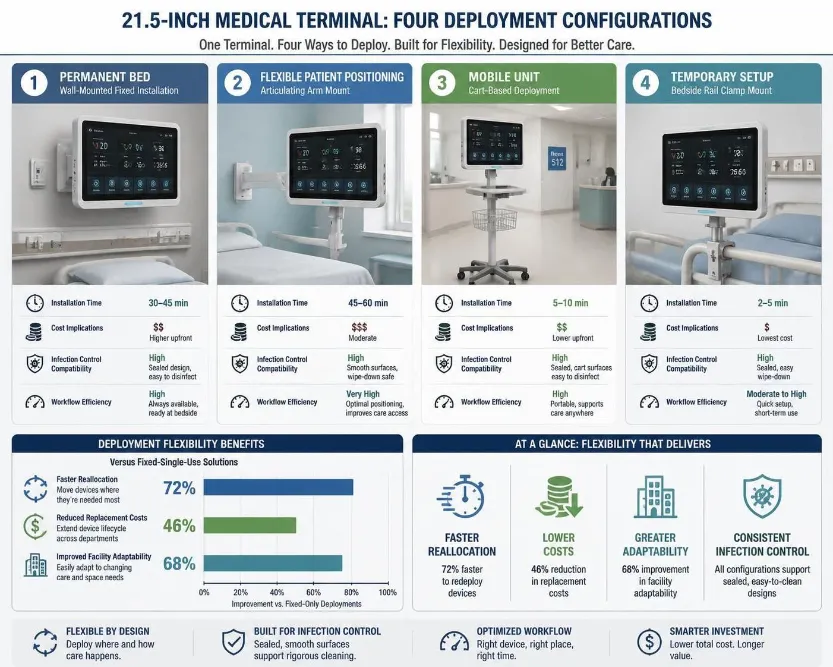
Hospital environments vary substantially. Some facilities feature fixed bed locations with dedicated electrical and network infrastructure. Others utilize mobile beds requiring flexible equipment positioning. Some rooms accommodate wall-mounted displays; others require articulating arms or cart-based systems. A single display form factor cannot effectively address this diversity. Modular mounting systems enable a single 21.5-inch terminal to function across these varied deployment scenarios.
A modular mounting architecture includes multiple adapter options: fixed wall mounts for permanent installations, articulating arms for flexible positioning, mobile carts for portable deployment, and bedside rail clamps for secure attachment to patient beds. Facilities purchase a single terminal model and deploy it across diverse locations using appropriate mounting hardware. This standardization simplifies procurement, reduces inventory complexity, and enables equipment reallocation as facility needs evolve.
Modular systems particularly benefit healthcare facilities undergoing renovations, expansions, or operational changes. Rather than replacing displays when mounting locations change, facilities simply remount existing terminals using alternative hardware. This flexibility reduces capital expenditure during facility transitions and enables rapid response to changing clinical needs. A terminal deployed as a wall-mounted display in one location can be repurposed as a mobile unit in another, extending asset value and improving return on investment.
Installation flexibility also addresses infection control requirements. Wall-mounted terminals can be positioned at optimal heights for staff access while remaining out of direct patient contact. Articulating arms enable positioning for patient viewing while maintaining staff accessibility. Mobile carts enable equipment relocation for enhanced disinfection and maintenance. The ability to adjust positioning for infection control protocols without purchasing new hardware represents a significant operational advantage in healthcare environments with strict environmental management requirements.
| Feature Category | Standard Display | 21.5″ Medical Infotainment Terminal | Clinical Impact |
|---|---|---|---|
| Screen Size | 10-17 inches | 21.5 inches | 35-40% larger viewing area; improved visibility for patients and staff; reduced eye strain during extended use |
| Cooling System | Active fan cooling | Passive fanless design | Eliminates noise, maintenance requirements, and dust accumulation; improves infection control compliance |
| Dust/Water Protection | None (standard IP20) | IP65 rating | Survives washdown procedures, spill incidents, and aggressive disinfection; extends device lifespan 2-3 years |
| Authentication | External peripherals required | Integrated MSR/smart card reader | Streamlined workflow; reduced equipment clutter; improved security compliance; single authentication point |
| Patient Communication | Separate nurse call device | Integrated nurse call system | Unified patient interface; improved response times; contextual staff alerts; data-driven analytics |
| Mounting Options | Fixed wall mount only | Modular mounting system | Flexible deployment across varied locations; simplified reallocation; reduced capital costs during renovations |
| Power Consumption | 60-80W typical | 45-65W (fanless efficiency) | 15-25% lower energy costs; reduced HVAC load; environmental sustainability |
| Clinical Integration | Limited connectivity | EHR, pharmacy, monitoring systems | Comprehensive clinical workflow support; medication verification; real-time data access |
| Patient Satisfaction | Basic entertainment | Entertainment + clinical engagement tools | Improved patient experience; reduced anxiety; enhanced communication with care team |
| Total Cost of Ownership (5 years) | $3,500-$4,500 | $4,200-$5,500 | 20-30% higher initial cost offset by reduced maintenance, extended lifespan, and operational efficiency gains |
Healthcare Facility Implementation Considerations
Successful deployment requires comprehensive planning addressing clinical workflow integration, staff training, patient education, and ongoing technical support.
Implementing 21.5-inch bedside medical infotainment terminals across healthcare facilities represents significant operational change. Clinical staff must learn new interfaces and workflows. IT departments must integrate terminals with existing EHR systems, pharmacy systems, and monitoring platforms. Patient education materials must explain entertainment and communication features. Successful implementation requires structured planning and change management.
Pilot programs provide essential validation before facility-wide deployment. Implementing terminals in a single unit or floor enables identification of workflow issues, interface challenges, and integration problems before enterprise rollout. Staff feedback from pilot programs informs configuration adjustments, training program refinement, and deployment strategies. Healthcare facilities typically conduct 6-12 week pilots before committing to facility-wide implementation.
Staff training programs must address both clinical and entertainment functions. Nurses require training on clinical authentication, accessing patient information, and using integrated nurse call systems. Housekeeping staff require training on safe disinfection procedures compatible with IP65 ratings. Patient services staff require training on patient orientation and troubleshooting common issues. Comprehensive training programs reduce implementation friction and accelerate adoption.
Integration with existing IT infrastructure determines deployment success. Terminals must connect securely to EHR systems, pharmacy systems, and patient monitoring platforms. Network bandwidth must support simultaneous access from hundreds of bedside terminals. IT teams must develop security policies, backup procedures, and disaster recovery protocols. Healthcare facilities typically allocate 3-6 months for technical integration before clinical deployment.
Frequently Asked Questions
Q: How does a 21.5-inch display compare to smaller 10-17 inch bedside terminals for patient visibility?
A: The 21.5-inch display provides 35-40% more screen area, significantly improving visibility for patients with vision impairment or age-related decline. Text can be displayed at larger sizes without reducing information density. Multiple clinical parameters can display simultaneously without excessive scrolling. For elderly patients—the primary bedside terminal users—this improved visibility substantially enhances usability and satisfaction. Additionally, larger displays reduce eye strain during extended viewing, supporting patient rest and recovery.
Q: What are the infection control advantages of fanless medical terminals?
A: Fanless design eliminates mechanical components that accumulate dust and harbor microorganisms. The sealed thermal architecture prevents airborne pathogens from entering the device interior. Reduced mechanical complexity means fewer components requiring maintenance and fewer potential failure points. Fanless terminals can be safely subjected to aggressive disinfection protocols without risk of mechanical damage. Healthcare facilities report improved compliance with environmental infection control standards and reduced device-related infection rates when deploying fanless bedside terminals.
Q: Can bedside terminals with integrated nurse call systems replace traditional wall-mounted call buttons?
A: Modern implementations typically retain traditional call buttons as backup systems for patients unable to use touchscreen interfaces or in emergency situations requiring immediate response. However, integrated bedside terminal nurse call systems handle 80-90% of routine patient requests, reducing pressure on traditional call button systems. The integration provides advantages of contextual information, data analytics, and unified communication while maintaining safety redundancy through traditional call buttons.
Q: How does IP65 rating affect device maintenance and cleaning procedures?
A: IP65 rating enables direct spray disinfection using approved healthcare cleaning solutions. Housekeeping staff can safely apply alcohol-based disinfectants, quaternary ammonium compounds, and other hospital-approved cleaning agents without risk of device damage. Standard displays require manual wiping with minimal moisture to prevent damage; IP65-rated terminals tolerate aggressive washdown procedures. This capability simplifies disinfection protocols, reduces time required for terminal cleaning, and improves infection prevention compliance.
Q: What security considerations apply to integrated smart card readers in bedside terminals?
A: Integrated smart card readers must comply with HIPAA security standards, support role-based access control, and maintain audit trails of all authentication events. Terminals must automatically log out after defined inactivity periods to prevent unauthorized access. Smart card credentials must be encrypted during transmission and storage. Healthcare IT teams must implement comprehensive security policies governing credential management, access permissions, and incident response. Properly configured integrated readers enhance security by eliminating external reader cables that create security vulnerabilities and contamination vectors.
Q: How do modular mounting systems support facility flexibility and cost management?
A: Modular mounting enables a single terminal model to function across diverse deployment scenarios using different mounting hardware. Wall-mounted terminals can be converted to mobile carts, articulating arms, or bedside rail clamps without purchasing new displays. During facility renovations or operational changes, terminals can be quickly remounted in new locations. This flexibility reduces capital expenditure during facility transitions and enables equipment reallocation as clinical needs evolve. Facilities deploying hundreds of terminals across multiple units experience substantial cost savings through standardized hardware and flexible deployment.
Latest Content
- The Ultimate Guide to Choosing a Medical Display Manufacturer (2026)
- Reshaping the Ward Experience: From Hardware Terminals to Supply Chain Strategy
- Bedside Terminal: The Complete Guide to Patient-Centric Hospital Technology
- How Brazilian Hospitals Use Bedside Information Terminals to Boost Patient Satisfaction & Efficiency
- Bedside Infotainment System: 6 Proven Patient Outcome Benefits