
- How Do Hospital Patient TV Systems Work with EMR Integration?
- Benefits of Interactive Patient Care System for Nurses
- Patient Infotainment Terminal Cost 2026
- Antimicrobial Medical Grade TV for Hospitals: Why It Matters
- Smart Hospital Bedside Terminal Comparison: LG vs Samsung vs Sony vs Philips
- How to Choose a Patient Infotainment Terminal Vendor
- Hospital TV System with Meal Ordering and Video Calls: Case Study
- Frequently Asked Questions (FAQ)
- Conclusion: Future-Proofing Your Patient Room Technology
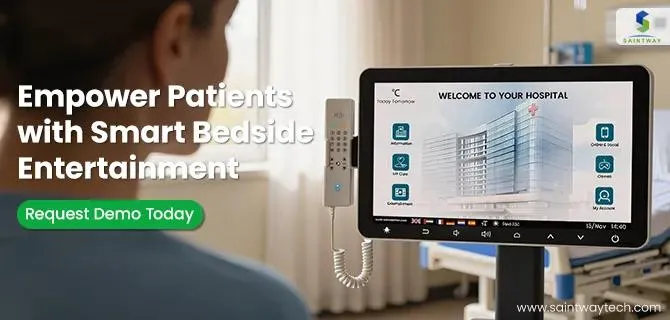
The hospital patient TV system has quietly evolved from a basic ceiling-mounted entertainment relic into the central nervous system of the modern smart hospital. Today’s interactive patient care system integrates directly with your EHR, manages nurse calls, handles meal orders, and even powers virtual nursing. If your 2026 capital budget still treats patient TVs as “commodity displays,” you are leaving money—and patient satisfaction—on the table.
This guide analyzes how leading health systems (Emory, Houston Methodist, UT Health San Antonio) deployed MyChart Bedside TV to achieve a staggering 96% increase in patient engagement. We will walk through vendor selection, cost analysis, technical integration, and the exact ROI framework we use with hospital clients.
How Do Hospital Patient TV Systems Work with EMR Integration?
Understanding the technical backbone is step one. The days of coax cables and static broadcast channels are over.
The 3-Layer Architecture of a Modern System
| Layer | Component | Real-World Example |
|---|---|---|
| Hardware | Medical-grade smart TV + Bedside terminal | Philips Bedside TV with antimicrobial housing (JIS Z2801 compliant) |
| Software | Patient engagement platform | Epic MyChart Bedside, pCare, Lincata LincTV |
| Integration | API middleware (HL7/FHIR) | LincTV integrates directly with Epic’s MyChart Bedside via the Epic Toolbox |
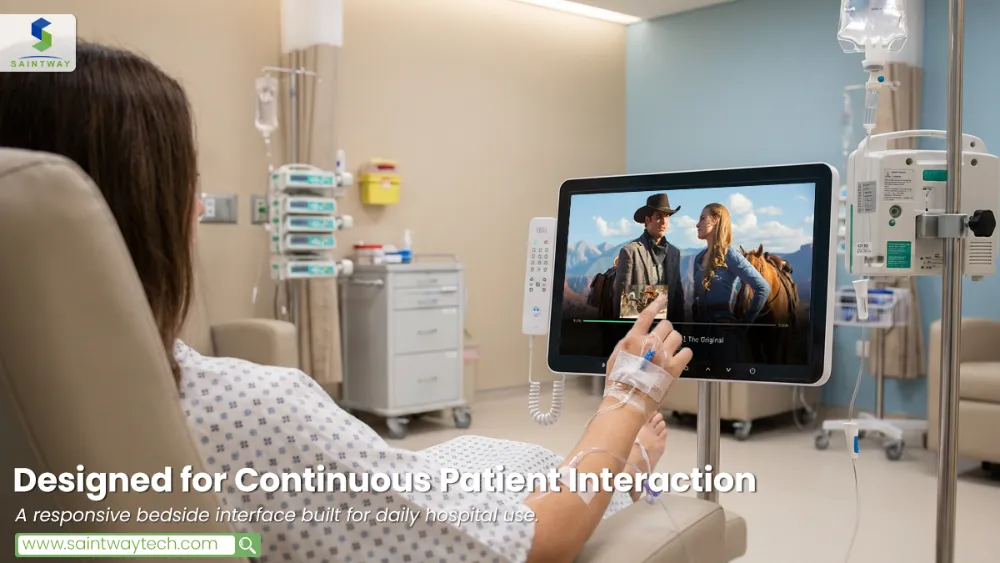
When a nurse enters a patient’s room, an integration between the hospital patient TV system and a real-time location service automatically displays the nurse’s name, photo, and role on the screen. This simple feature, described by patients as “deeply reassuring,” is only possible when your TV system speaks the same language as your nurse call integration and HIS integration.
The EMR Connection
The real magic happens on the backend. Using HL7 FHIR interfaces (typically costing 15,000–40,000 per integration point), the TV pulls live data from your EMR/EHR. Patients can see:
- Their daily schedule and care plan goals
- Intended discharge date (reducing anxiety)
- Lab results as they are released
- Medication lists and educational materials
Per a 2025 study in NEJM Catalyst, facilities with integrated bedside systems saved an average of 28 minutes per nurse per shift in non-clinical administrative tasks.
Benefits of Interactive Patient Care System for Nurses
Ask any floor nurse about their biggest frustration, and “call lights for ice chips” will rank near the top. The interactive patient care system eliminates that specific pain point.
Automated Non-Clinical Requests
Instead of a call light triggering a physical walk to the room just to discover the patient wants a warm blanket, patients now use the MyChart Bedside TV to send non-urgent messaging via Secure Chat. The request shows up exactly where it needs to go:
- Housekeeping for linen changes
- Dietary for meal orders
- Engineering for temperature complaints
A nurse manager at Emory Healthcare shared that this single feature reduced interruptions to clinical staff by over 40% during medication pass hours.
Virtual Nursing Support
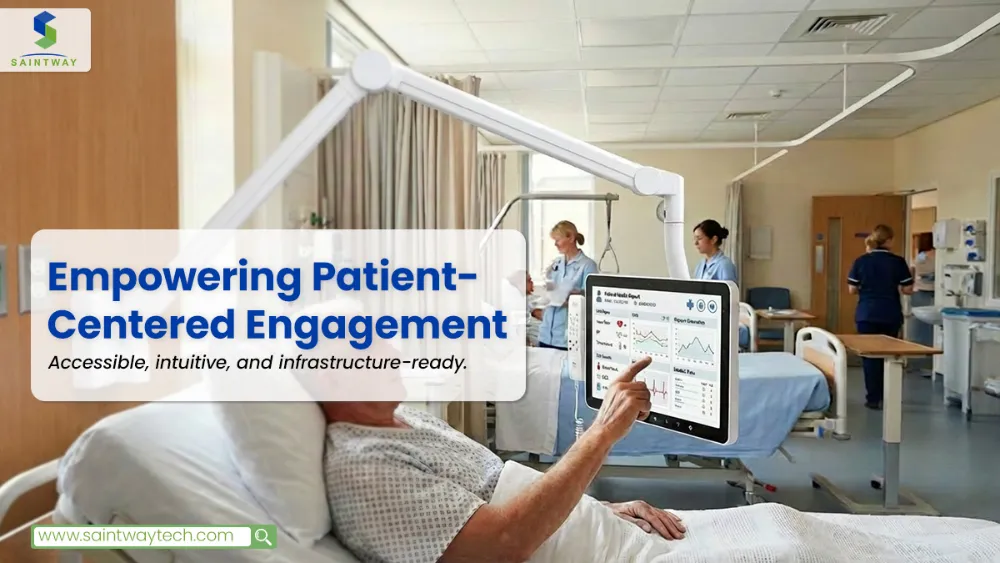
At UT Health San Antonio’s 144-bed Multispecialty and Research Hospital, virtual nurses use the patient infotainment terminal to check on patients triggered by clinical data (vital signs, fall risk). They appear on the 65-inch display via integrated camera, reassure the patient their request was received, and coordinate with the bedside nurse. The result is faster response times and lower burnout.
Patient Infotainment Terminal Cost 2026
This is the question every CFO asks. Let us break down the real numbers.
Hardware and Software Cost Ranges
| Component | Estimated Cost (USD) | Notes |
|---|---|---|
| Medical-grade 55″ TV (basic) | 800–1,500 per unit | Antimicrobial coating adds 15-20% |
| Bedside terminal device (LincTV) | 200–400 per unit | Plugs into any HDMI port |
| Software license (per bed/year) | 150–300 | MyChart Bedside, pCare, etc. |
| Installation & cabling | 300–600 per bed | Depends on existing infrastructure |
| Ongoing support/maintenance | 50–100 per bed/year | Firmware updates, help desk |
A 200-bed hospital can expect a total project cost between 150,000and150,000and400,000 for a full deployment, depending on existing infrastructure. The procurement notice from Suining Central Hospital (China) for “Smart Medical Digital TV Service” came in at approximately $79,500 USD for a single facility’s multi-year service package.
The ROI Calculation
Hospital administrators need a positive return within 24-36 months. The business case rests on three pillars:
1. Labor Efficiency
28 minutes saved per nurse per shift × 50 nurses × 365 days = 8,518 nursing hours reclaimed annually. At an average RN salary of 50/hour(includingbenefits),thatis∗∗425,900 in value**.
2. Readmission Reduction
The highest risk period is the transition home. Patient education video delivered via the bedside terminal with “teach-back” functionality (short quizzes confirming understanding) directly reduces 30-day readmission penalties under value-based care models. Avoiding just 5 readmissions per month at 15,000averagepenaltysaves∗∗900,000 annually**.
3. HCAHPS Improvement
Medicare reimbursements are tied to patient satisfaction. Access to personal health information directly lifts scores for:
- Responsiveness of care team
- Communication about medications
- Communication about discharge plans
Antimicrobial Medical Grade TV for Hospitals: Why It Matters
This is not marketing hype. Hospital-acquired infections (HAIs) cost the US healthcare system approximately $28 billion annually. High-touch surfaces like TV bezels and remote controls are fomites.
The JIS Z2801 Standard
When evaluating a medical grade TV, look for JIS Z2801 compliant or ISO 22196 certification. This tests the ability of a surface to kill 99.99% of bacteria within 24 hours.
The Philips Bedside TV features antimicrobial housing that actively inhibits:
- Staphylococcus aureus
- Escherichia coli
- Klebsiella
Silver Ion Technology
The mechanism is fascinating. Nano-silver technology releases silver ions that perforate the glycoprotein structure of the bacterial cell wall. The bacteria require protease for metabolism; silver ions cause protein denaturation, rendering the bacteria unable to reproduce. Silver ions revert to silver atoms after destroying the bacteria and continue working.
For existing displays, anti-bacterial laminate film can be applied to create an antimicrobial surface with greater than 90% optical transparency. This is an excellent retrofit option if a full hardware refresh is not in this year’s budget.
Smart Hospital Bedside Terminal Comparison: LG vs Samsung vs Sony vs Philips
If you are evaluating vendor options, here is the 2026 landscape based on actual hospital RFPs.
Vendor Feature Comparison Matrix
| Feature | LG Pro:Centric | Samsung LYNK Cloud | Sony BRAVIA Professional | Philips Bedside TV |
|---|---|---|---|---|
| Antimicrobial housing | Optional film | Optional film | Optional film | Standard (JIS Z2801) |
| AirPlay hotel function | Yes (Pro:Centric Smart) | Yes (HBU8000 series) | Limited | No |
| Guest streaming | Netflix, YouTube | Netflix, Hulu | Netflix, Apple TV+ | Basic |
| EMR integration | Via middleware | Via middleware | Via middleware | Yes (Epic, Cerner) |
| Pillow speaker interface | Standard | Standard | Requires adapter | Integrated |
| Best for… | Large chains, existing LG shops | Samsung-heavy IT environments | High-end image quality needs | Clinical-first facilities |
The LincTV Wildcard
One device deserves special mention: Lincata’s LincTV. It is a small HDMI dongle (similar to a Fire TV stick) that transforms any existing hospital television into an interactive patient care hub. Priced significantly lower than a full room refresh, it integrates directly with Epic’s MyChart Bedside and is available in the Epic Toolbox under “Bedside TV Hardware”.
For hospitals already on Epic, this is the most cost-effective path to smart room capabilities.
How to Choose a Patient Infotainment Terminal Vendor
Based on dozens of selection committee meetings, here is the checklist we provide clients.
The 2026 Vendor Selection Criteria
1. API-First Architecture
Does the system integrate with your existing nurse call system, EHR, and smart building controls without middleware that requires constant patches? Avoid closed ecosystems.
2. WCAG 2.1 AA Accessibility Compliance
Medicare is watching. The interface must support:
- Text-to-speech for vision-impaired patients
- Voice control for motor-impaired patients
- High-contrast modes
3. Multilingual Support
Not just a static language setting. Real-time translation of patient education materials and interface text is becoming baseline.
4. Data Privacy (HIPAA)
Patient-specific data should never reside on the device itself. It must stream from a secured server and clear immediately upon discharge.
5. Future-Proofing
Ask: “Does this terminal support smart room controls for blinds, lighting, and temperature?” This is the next frontier.
Hospital TV System with Meal Ordering and Video Calls: Case Study
Let us walk through a real 24-hour patient journey with a fully deployed patient TV system.
Scenario: Mrs. Davis, Day 2 Post-Knee Replacement
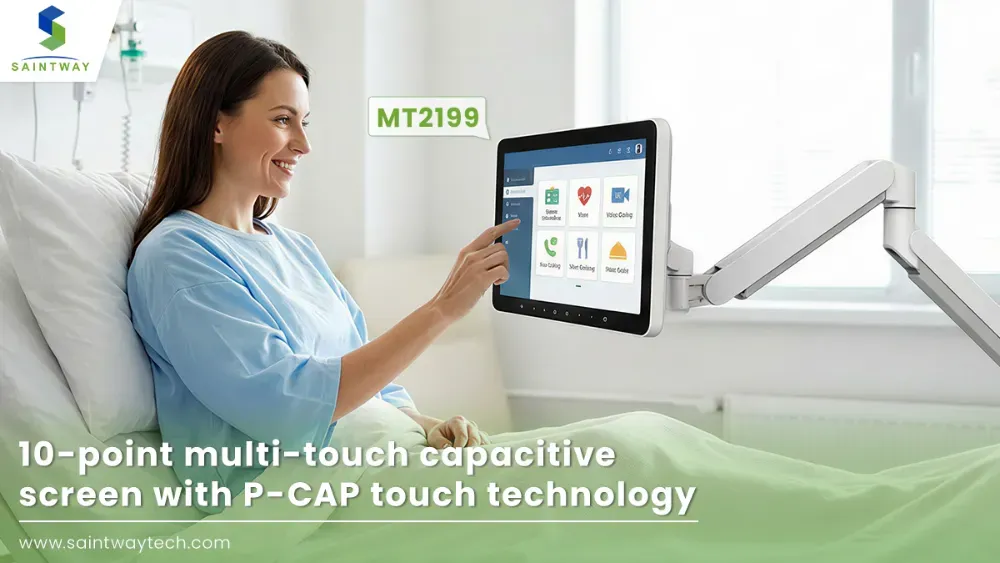
8:00 AM – Mrs. Davis wakes up. Her hospital patient TV system welcome screen displays her name, care team (nurse Sarah, Dr. Patel), and today’s goal: “Walk to bathroom with assistance.”
10:00 AM – She feels hungry for lunch but does not want to bother anyone. She navigates to meal ordering, selects a heart-healthy salmon plate, and the order goes directly to dietary.
2:00 PM – Her daughter calls to check in. Mrs. Davis answers a video call directly through the bedside terminal. The camera is integrated; she does not need to hold her phone.
6:00 PM – A patient education video about post-op exercises plays automatically. She watches a 3-minute animation of proper crutch use.
8:00 PM – Before sleep, she uses the smart room controls to dim the lights, close the blinds, and lower the room temperature.
Result: Mrs. Davis rates her stay 10/10. Hospital avoids a readmission because she understood her discharge instructions.
Frequently Asked Questions (FAQ)
Q: What is the difference between a standard commercial TV and a medical-grade patient TV system?
A: Medical-grade units feature JIS Z2801 compliant antimicrobial housing, UL 60601 certification for electrical safety near oxygen, pillow speaker interfaces with nurse call integration, and software that supports HIPAA-compliant secure login. A Best Buy TV has none of these.
Q: How much does it cost to integrate MyChart Bedside TV with an existing Epic installation?
A: If your hospital already licenses Epic MyChart Bedside for mobile devices (tablets, phones), adding Bedside TV through a solution like LincTV typically requires minimal additional licensing costs. The integration is now available directly in the Epic Toolbox. You are primarily paying for the hardware (200–400 per LincTV device).
Q: Can patients stream Netflix from their own account on hospital patient TV systems?
A: Yes, on most modern platforms. Systems like LG Pro:Centric and Samsung LYNK Cloud support AirPlay hotel function, allowing patients to cast content from their iPhone or iPad using a QR code displayed on the TV. All personal data is erased at checkout.
Q: Do hospital patient TV systems work during a network outage?
A: This varies dramatically by vendor. Systems with on-device caching continue displaying patient education and basic entertainment. Systems that are purely “thin clients” (streaming everything from a central server) go dark. Always ask for offline mode capabilities in your RFP.
Q: What is the typical lifespan of a bedside infotainment terminal?
A: Plan for a 5-7 year refresh cycle. The display hardware often lasts longer, but the Android/operating system version support and security patches typically sunset around year 5. LincTV’s removable HDMI dongle architecture allows you to replace the smart module without touching the display—a clever way to extend hardware life.
Conclusion: Future-Proofing Your Patient Room Technology
The shift from passive entertainment to active interactive patient care is no longer optional. By 2027, most value-based care contracts will assume these capabilities as baseline. Whether you choose the clinical-first approach of Philips, the streaming ecosystem of LG and Samsung, or the retrofit flexibility of LincTV with Epic MyChart Bedside, the key is integration.
Three concrete actions for your next capital planning cycle:
- Audit your current TVs. If they lack HDMI ports with CEC control, start budgeting for replacement.
- Ask your EHR vendor (Epic, Cerner, Meditech) what bedside TV integrations they already support.
- Demand JIS Z2801 antimicrobial surfaces on any new medical display purchase.
Your patients are already walking into your facility expecting the same digital convenience they have at home and in hotels. Give it to them. Your HCAHPS scores will thank you.

Latest Content
- The Ultimate Guide to Choosing a Medical Display Manufacturer (2026)
- Reshaping the Ward Experience: From Hardware Terminals to Supply Chain Strategy
- Bedside Terminal: The Complete Guide to Patient-Centric Hospital Technology
- Integrated Bedside Infotainment: 2026 Implementation & Security Guide
- How Patient Entertainment Systems Improve Hospital Outcomes & Reduce Healthcare Costs | 2026 Guide