
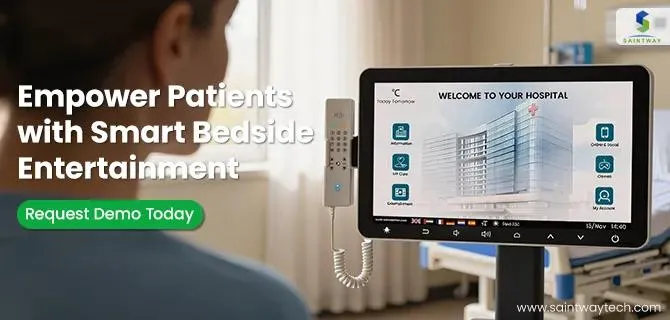
When evaluating a hospital bedside infotainment solution, most CIOs and nursing directors focus on the hardware. That’s a mistake. In 2026, the real value isn’t the screen—it’s how the interactive patient care system consolidates clinical workflows, entertainment, and patient engagement into a single, secure endpoint.
- How Does Hospital Bedside Infotainment Improve Patient Satisfaction?
- What Is the ROI of Bedside Infotainment for Hospitals?
- How to Integrate Bedside Terminals with EHR and Nurse Call Systems?
- What Are the Best Interactive Patient Care System Vendors?
- How to Choose a Bedside Infotainment System for a Smart Hospital Room?
- Future-Proofing: AI and Ambient Intelligence at the Bedside
- Frequently Asked Questions (FAQ)
- Summary: The Clinical & Operational Hub
The market has shifted. According to recent forecasts, the intelligent bedside interactive terminals market was valued at USD 1.36 billion in 2025 and is projected to reach USD 2.74 billion by 2032, growing at a CAGR of 10.45%. This growth isn’t driven by movies on demand. It’s driven by hospitals realizing that a bedside terminal can be a revenue-generating, labor-saving clinical asset.
Below, we break down the 2026 playbook—moving beyond the legacy “TV-on-an-arm” model to an Interactive Patient Care System (IPCS) .
How Does Hospital Bedside Infotainment Improve Patient Satisfaction?
The direct correlation between bedside technology and HCAHPS scores is the #1 driver for adoption. Legacy systems created frustration—poor resolution, hard-to-use nurse call buttons, and zero personalization.
Modern smart bedside terminals flip the script. They offer “digital autonomy.” Patients expect the same control they have at home: voice-activated TV controls, personalized streaming, and the ability to adjust room temperature or lighting from a tablet.
Real-world impact:
- Service recovery: A 2024 study found that patients who could order meals or request housekeeping via the terminal reported higher satisfaction scores than those using the call light.
- Noise reduction: By digitizing non-urgent requests (e.g., “extra pillow”), audio alarms on the unit are reduced, creating a quieter healing environment.
- Data point: Facilities using integrated systems saw an 8% increase in overall patient satisfaction and a 42% increase in satisfaction with health education post-deployment.
What Is the ROI of Bedside Infotainment for Hospitals?
CFOs often ask, “Does this just cost me money?” No. The ROI calculus changed in 2025. We are looking at three specific pillars of financial return:
- Labor Efficiency (The 28-Minute Rule)
A 2025 study cited in NEJM Catalyst noted that nurses spend an average of 28 minutes per shift on non-clinical administrative tasks (finding blankets, delivering paper menus, answering non-urgent call lights). By automating these requests through a patient engagement solution, facilities reclaimed that time for clinical care. - Readmission Reduction (Value-Based Care)
Interactive patient education works better than paper. Systems offering “teach-back” functionality (quizzes that confirm the patient understood discharge instructions) directly reduce 30-day readmission penalties. Some providers using platforms like Get Well (now GW RhythmX) have reported readmission reductions of over 65%. - Service Line Revenue
In-room meal ordering increases food service revenue capture. Credit card readers on bedside terminals allow for premium entertainment rentals, turning a cost center into a minor profit center or subsidy model.
How to Integrate Bedside Terminals with EHR and Nurse Call Systems?
For a CTO or IT director, this is the make-or-break question. If the terminal doesn’t talk to your EHR or HIS, it’s just an expensive toy.
The Architecture Checklist (2026 Standards)
- HL7/FHIR Integration: The system must offer bidirectional communication. When a doctor orders a new pain med, the terminal prompts the patient to rate their pain. When the patient watches a discharge video, that completion data auto-populates the EHR.
- Nurse Call Integration: The distinction between a call light and a terminal is gone. A request for pain management logged via the terminal should appear as a specific task on the nurse’s handheld device (Vocera, etc.), not a generic room alarm.
- Zero-Touch Mandate: In a post-COVID world, hardware must support UV-C light disinfection and survive hospital-grade chemical wipes (IPX3 or higher) without screen degradation.
| Feature | Legacy System (2010s) | Modern IPCS (2026) |
|---|---|---|
| Primary Use | TV & Phone | Clinical Workflow & Engagement |
| Integration | None | Full HL7/FHIR + Nurse Call |
| Patient Input | Call light button | Voice control / Predictive AI |
| Cleaning Standard | Porous plastic | Antimicrobial glass / UV-C ready |
| Data Output | None | Auto-documentation to EHR |
What Are the Best Interactive Patient Care System Vendors?
The vendor landscape has consolidated rapidly. You are likely looking at a shortlist of established players and innovative newcomers.
Market Leaders (2026):
- GetWellNetwork (Now GW RhythmX): Recently combined with RhythmX AI and backed by SymphonyAI Group. They serve 150+ health systems and have touched over 85 million patients, including 8 million U.S. military veterans. Their strength is in AI-driven precision care and patient engagement.
- Lincor (MEDIVista): A long-standing player in Europe and Asia, now expanding in the US. Strong in clinical access and “bedside to door” workflows.
- Advantech & Onyx Healthcare: Hardware-first providers offering ruggedized, infection-control focused terminals for those building custom software stacks.
- SONIFI Health & BEWATEC: Strong in Europe for integrated TV/telephony and patient entertainment.
Pro Tip: When evaluating, ask for their API documentation before the sales demo. If they hesitate, walk away. You need API-first architecture to avoid vendor lock-in.
How to Choose a Bedside Infotainment System for a Smart Hospital Room?
Selecting the right smart hospital room technology requires a multidisciplinary team (IT, Nursing, Biomed, Patient Experience). Use this 5-point checklist:
- Accessibility Compliance (WCAG 2.1 AA): Is it usable by the visually impaired (text-to-speech) and motor-impaired (voice control)? This is no longer optional; it’s a legal requirement in many jurisdictions.
- Multilingual Support: Does it support real-time language translation for a diverse patient population? Static language menus are insufficient in 2026.
- Cybersecurity: Is the platform HIPAA-compliant out of the box? Patient data should never reside on the device; it should live on a secured server or cloud.
- Modular Hardware: Can you upgrade the CPU or screen without replacing the entire mount and cabling? Modularity protects against tariff-induced cost spikes and tech obsolescence -2.
- Evidence Base: Ask for case studies. Ask for the “pilot data” showing reduced call light volume or improved HCAHPS domain scores.
Future-Proofing: AI and Ambient Intelligence at the Bedside
Looking toward 2027, the static terminal is evolving into an ambient intelligence platform.
- Predictive vs. Transactional: Instead of the patient pressing “call nurse” for a blanket, the system’s AI (with consent) detects the room temperature dropped below comfort levels and the patient is awake. It prompts: “I noticed it’s cool. Adjust thermostat or request a blanket?”.
- Precision Care: The new GW RhythmX platform is using AI to combine clinical, payer, and social data to deliver personalized treatment recommendations directly to the bedside terminal, moving from “sick care” to true healthcare.
Frequently Asked Questions (FAQ)
Q: Does a bedside infotainment system actually reduce nurse workload?
A: Yes. By automating non-clinical requests (meal orders, housekeeping, tech support), studies show a reduction of up to 28 minutes per nurse per shift in task-based interruptions.
Q: Is it better to use patient-owned mobile devices or hospital bedside terminals?
A: A hybrid approach (Bring Your Own Device + bedside terminal) is best. Bedside terminals ensure equity for patients without smartphones and offer robust integration with medical devices (infusion pumps, vital signs monitors) that personal phones cannot.
Q: What is the average cost of installing bedside infotainment terminals?
A: Costs vary wildly based on volume and software licensing. Expect $3,000 to $7,000 per bed for hardware + installation, plus a monthly SaaS fee ($30-$60 per bed) for software and updates. Subscription models are becoming standard to avoid massive CapEx.
Q: How do tariffs affect the 2026 market for interactive terminals?
A: Tariffs on imported electronics (touchscreens, CPUs) have increased hardware costs by an estimated 10-15% in North America and Europe. This is pushing hospitals toward cloud-based deployments and modular hardware that allows for component swaps rather than full replacements.
Summary: The Clinical & Operational Hub
The hospital bedside infotainment solution has grown up. It is no longer just a toy for bored patients. In 2026, it is a core clinical asset that manages pain, educates on discharge, facilitates telehealth, and integrates directly with your EHR and nurse call systems.
For hospital executives, the question is no longer “Should we buy this?” but “How do we integrate this into our value-based care model to maximize ROI and patient safety?”
Author Bio: Michael Chen is a former clinical IT project manager who has led digital transformation projects in 12 major medical centers across the US and EU, focusing on patient engagement and workflow optimization.
Latest Content
- What Is a Smart TV Box? Complete Guide to Streaming Devices in 2026
- Selecting the Right TV for Hospital Beds: A Practical Guide to Patient Entertainment and Comfort
- Hospital Patient Room TV: Specs & Buying Guide
- Patient Infotainment Terminal Market: Why "Infotainment" is the ROI Driver for Smart Hospitals in 2026
- Understanding Bedside TVs in Hospitals: Complete Patient Guide 2026