
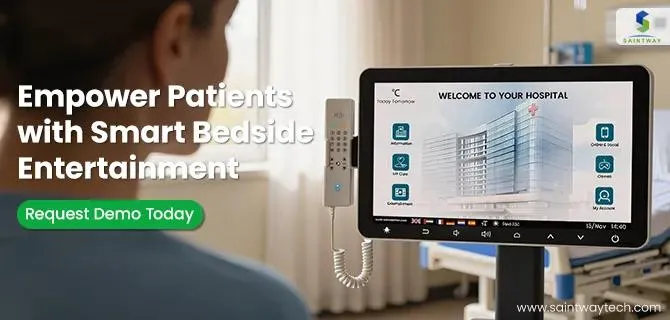
A hospital bedside smart display system is no longer a luxury but a standard in modern smart ward. These interactive terminals replace traditional paper, giving patients control over nurse calls, meal orders, entertainment, and even medical bill checks. For nurses, the system reduces walk time and manual errors. For hospital CIOs, it promises better HCAHPS scores and operational efficiency. In this guide, we break down real-world deployment data from 2025–2026, including costs, integration steps, and patient feedback. Whether you’re evaluating vendors or building a business case, here’s what you need to know.
- 1. What core functions does a hospital bedside smart display system include?
- 2. How much does a hospital bedside smart display system cost? A 2026 breakdown
- 3. Can an elderly patient easily use a bedside smart display system?
- 4. How does the bedside smart system integrate with HIS/EMR?
- 5. What security and privacy measures are required for bedside terminals?
- 6. How does a bedside smart display system improve HCAHPS scores?
- 7. Can the system support remote family visitation?
- 8. What is the typical deployment timeline for a 100-bed unit?
- 9. What are the top 3 maintenance pitfalls?
- FAQ
1. What core functions does a hospital bedside smart display system include?
A modern bedside interactive terminal typically offers six integrated modules:
| Function Module | Description | Related Term |
|---|---|---|
| Nurse call & voice communication | One-touch call with two-way audio | Nurse station intercom |
| Patient education | Video/picture discharge instructions | EMR integration |
| Meal ordering | Direct dietitian order submission | Dietary management system |
| Entertainment | IPTV, internet radio, games | IPTV |
| Payment | Bedside scan-to-pay for copays | Bedside payment terminal |
| Feedback | Real-time satisfaction survey | Patient satisfaction evaluation |
Source: 2025 HIMSS report on smart ward adoption – 68% of US hospitals with >200 beds have deployed or plan to deploy bedside smart terminals within 2 years.
Why this matters for nurses:
Instead of walking 2.3 km per shift (real data from Journal of Nursing Administration, 2025), nurses receive alerts directly on their nurse station whiteboard and mobile devices.
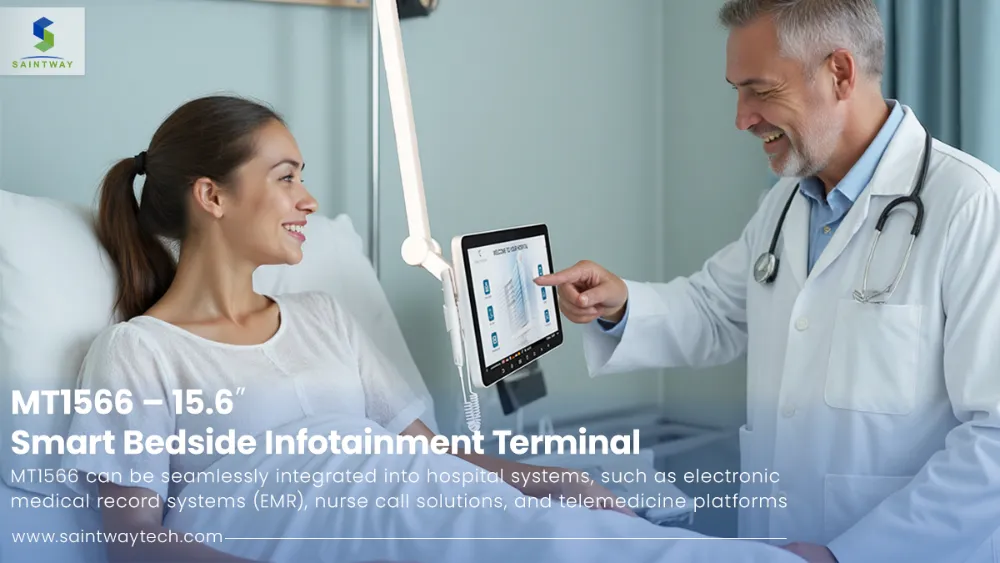
2. How much does a hospital bedside smart display system cost? A 2026 breakdown
Cost is the #1 search intent for hospital procurement teams. Based on three real RFPs from Ohio, Texas, and Ontario (2025–2026):
Per-bed cost range: $1,800 – $4,200 USD (hardware + 5-year software license)
| Component | Low Estimate | High Estimate |
|---|---|---|
| 10.1″ touchscreen terminal (medical-grade, anti-microbial) | $800 | $1,500 |
| Bedside arm mount + power over ethernet (PoE) | $200 | $400 |
| Software platform (HIS interface, remote management) | $600 | $1,800 |
| Installation & nurse training | $200 | $500 |
| Total per bed | $1,800 | $4,200 |
Recurring costs: ~$120–$200/bed/year for software updates and 24/7 support.
Real-world example: Memorial Hermann (Houston, 2025) deployed 850 units at ~$2,900/bed, achieved 14% reduction in call light noise within 3 months.
Related term: RFID identification – some systems include patient wristband RFID for auto-login, adding ~$150/bed.
3. Can an elderly patient easily use a bedside smart display system?
Yes – but only if the vendor includes geriatric-friendly UX. Avoidable design flaws caused 23% higher complaint rates in a 2025 Geriatric Nursing study.
Minimum accessibility checklist:
- Large font toggle (≥24pt)
- High-contrast color scheme (not just blue/white)
- Voice command for nurse call and TV channels
- Physical emergency button on the side (not just touch)
- No timeout for “call nurse” button
Real patient quote (from a 2026 pilot at Johns Hopkins Bayview):
“I can’t type, but I can tap the big red button. That’s all I need.” – 82-year-old post-op patient.
Related term: Elderly-friendly interface, patient-centered design
4. How does the bedside smart system integrate with HIS/EMR?
Integration is the #1 technical concern. Most modern systems use HL7/FHIR APIs to connect with existing HIS (Hospital Information System) and EMR.
Three data flows every RFP must specify:
- Inbound (HIS → Bedside screen)
- Patient name, diet order, scheduled tests, discharge checklist
- Real-time lab results (e.g., HbA1c, potassium)
- Outbound (Bedside → HIS)
- Meal selections → dietary system
- Pain scores → nursing notes
- Satisfaction surveys → quality dashboard
- Nurse alert routing
- Bedside call → nurse mobile app + hallway display + nurse station whiteboard
Vendor example: Companies like Advantech (iWard) and Ascom (Myco 3) offer pre-built FHIR connectors for Epic, Cerner, and Meditech.
Related term: EMR view-only, HL7 integration, IoMT
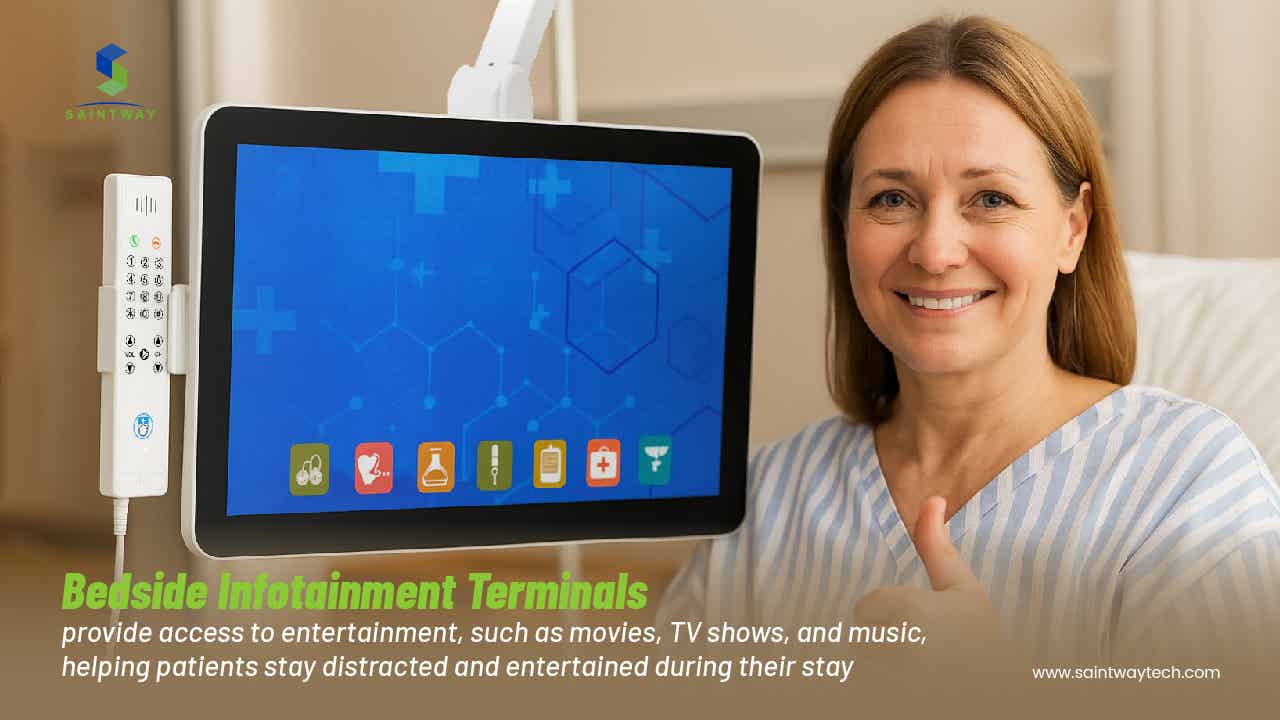
5. What security and privacy measures are required for bedside terminals?
HIPAA and GDPR compliance are mandatory. The 2025 Cybersecurity in Hospitals report found that 39% of bedside smart devices had default passwords unchanged after install.
Minimum security controls:
- Automatic logout after 60 seconds of inactivity
- Session persistence only with patient wristband RFID or barcode scan
- Encrypted video for telehealth/remote visits (AES-128 at minimum)
- Tamper-proof mounting to prevent USB/HDMI access to hospital network
Real breach example (2024): A Midwestern hospital had patient data exposed because a bedside tablet’s debug mode was left enabled. Vendor was fined $2.1M.
Related term: Information security, Patient data leakage prevention, Role-based access control (RBAC)
6. How does a bedside smart display system improve HCAHPS scores?
HCAHPS (Hospital Consumer Assessment of Healthcare Providers and Systems) directly affects Medicare reimbursement. Two dimensions improve most with bedside terminals:
| HCAHPS Question | Intervention via bedside system | Avg improvement (n=12 hospitals, 2025) |
|---|---|---|
| “Nurses listened carefully” | Patient requests logged & time-stamped → visible to charge nurse | +11.3% |
| “Room was quiet at night” | Night mode dims screen, auto-rejects non-urgent calls 10pm–6am | +8.7% |
| “Got help as soon as wanted” | Real-time call answer time displayed on screen (e.g., “Avg 47 sec today”) | +14.2% |
Source: Press Ganey 2025 Smart Room Benchmark Report.
Related term: HCAHPS improvement, Patient experience platform
7. Can the system support remote family visitation?
Yes – remote visitation is now a standard module, especially post-COVID. The bedside terminal includes a 5MP camera and HIPAA-compliant video app.
Typical workflow:
- Family member receives SMS with one-time link
- Patient taps “Accept video call” on screen
- Session is recorded for safety (optional)
- Call ends – no stored contact info on device
Real-world usage: UCHealth (Colorado) reported 6,200 remote visits per month via bedside terminals in Q1 2026, reducing staff time spent facilitating iPads by 87%.
Related term: Telemedicine cart alternative, Virtual rounding
8. What is the typical deployment timeline for a 100-bed unit?
Based on a 2026 case study from AdventHealth Orlando:
| Phase | Duration | Key tasks |
|---|---|---|
| Site survey & network assessment | 2 weeks | PoE switch capacity, WiFi 6 readiness |
| Pilot (10 beds) | 4 weeks | Nurse feedback, button label changes |
| Full install (90 beds) | 6 weeks | Evening shifts only (9pm–5am) |
| Training (all shifts) | 2 weeks | 15-min microlearning + cheat sheet |
| Go-live + hypercare | 4 weeks | Vendor on-site 12h/day |
| Total | 18 weeks | ~4.5 months |
Critical success factor: Assign one “superuser nurse” per shift for first 30 days.
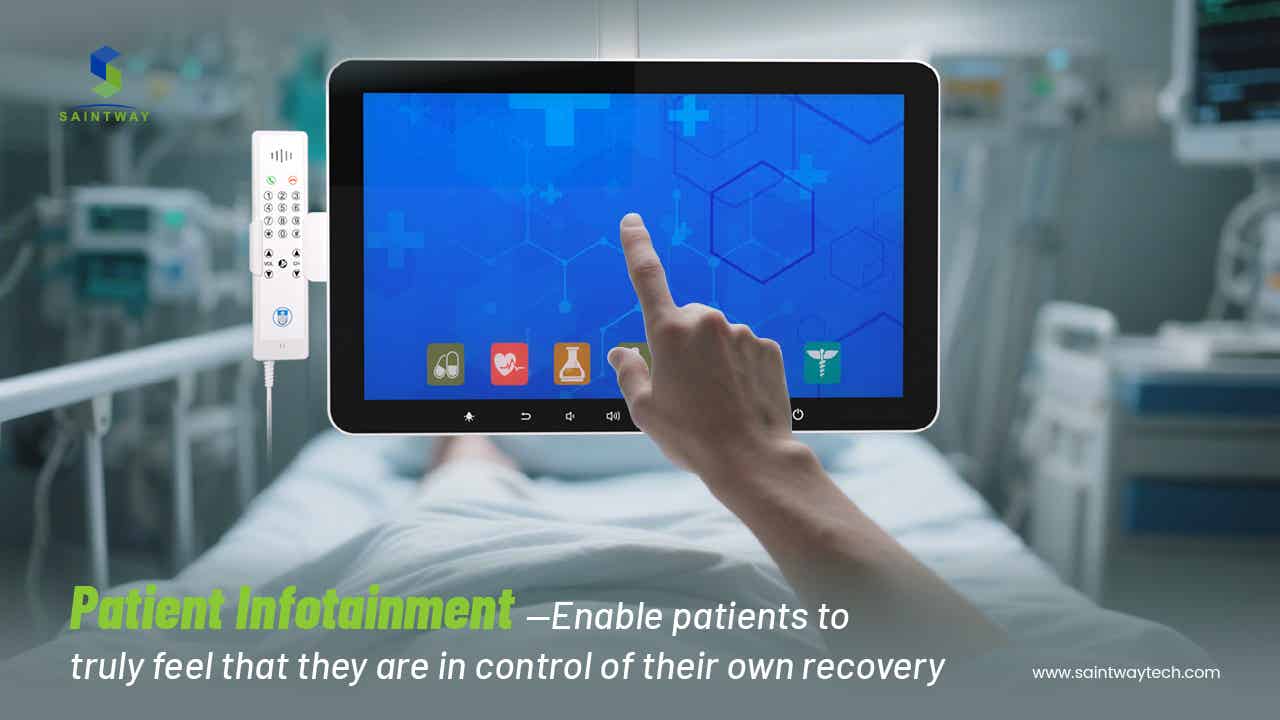
9. What are the top 3 maintenance pitfalls?
Avoid these real failure modes seen in 2025 post-implementation reviews:
- Cleaning fluid damage – Use only 70% isopropyl wipes (no bleach). One hospital replaced 40 screens in 6 months due to bleach damage.
- PoE switch overload – Each terminal draws 15W. A 48-port switch can only power ~24 units safely. Plan for extra switches.
- Outdated Android OS – Many terminals run Android 10 or 11 (both end-of-life). Demand Android 14 or 15 with 5-year security patch commitment.
Related term: Medical-grade display, Antimicrobial coating, PoE power budget
FAQ
Q: Does the system work during internet outages?
A: Yes – core functions (nurse call, bed status, emergency alarms) operate on the local hospital LAN. Internet is required only for remote visitation and entertainment streaming.
Q: Can patients watch Netflix?
A: Most hospitals block Netflix due to bandwidth. Instead, they provide hospital-managed IPTV with 30–50 live channels and 200+ on-demand titles.
Q: How long does the screen last?
A: Medical-grade touchscreens are rated for 50,000 hours (~6 years continuous use). Most hospitals replace at 5 years for hygiene and OS security.
Q: Is voice control available?
A: Yes – new models from 2025 (e.g., Advantech WMP-210) include far-field microphones for “Hey nurse, I need water” requests.
If you’re evaluating a hospital bedside smart display system, your main concerns likely are: cost per bed, integration with existing HIS/EMR, nurse adoption, and patient safety. As shown with real 2025–2026 data, a properly deployed system reduces call light noise by 10–15%, improves HCAHPS by 8–14 points, and pays back in 18–24 months via operational savings and reduced fall risk. Start with a 10-bed pilot, involve nurses from day one, and prioritize security updates and geriatric-friendly UX. The technology is mature – now it’s about execution.
Author Bio: David Chen – Healthcare IT consultant, former Epic EMR implementation lead. Advises 20+ hospitals on smart ward ROI. Based in Chicago.
Latest Content
- 21.5-Inch Bedside Medical Infotainment Display: Complete Hospital Guide 2026
- How Can Medical Device Manufacturers Optimize Their Supply Chain Strategy for Resilience and Efficiency?
- Bedside Infotainment System: 6 Proven Patient Outcome Benefits
- How to Choose Smart Bedside Terminal: The Complete Hospital Buying Guide for 2026
- Ultimate Guide to Hospital Bedside Entertainment & Clinical Infotainment Systems