
Introduction
As smart ward projects mature across Europe, North America, and other developed healthcare markets, hospitals are discovering a hard truth:
Digital transformation does not fail at the backend.
It fails at the bedside.
Hospitals may deploy advanced EMR systems, workflow engines, analytics platforms, and nurse call solutions—but if patient-facing interaction is fragmented, unintuitive, or disconnected, the entire system underperforms.
This is where the bedside terminal must be redefined—not as a device, but as a system layer at the center of smart ward architecture.
The Bedside Is Where Systems Meet Reality
From an architectural perspective, the bedside is the only point where:
· Clinical systems
· Operational workflows
· Patient experience
· Staff efficiency
converge in real time.
Unlike backend platforms that can tolerate abstraction, latency, or complexity, bedside interaction happens in moments that matter:
· A patient requests assistance
· A nurse responds under time pressure
· Information must be accurate, contextual, and immediately usable
If the bedside interface fails, no amount of backend sophistication can compensate.
Why Patient Interaction Must Be Treated as a System Layer
Many smart ward projects still treat bedside terminals as:
· A display
· An IPTV screen
· An accessory to nurse call
This mindset creates architectural limitations.
A system layer, by contrast, has defined responsibilities:
· It mediates between multiple backend systems
· It enforces role-based interaction (patient vs. nurse vs. staff)
· It provides real-time, context-aware access to services
· It remains stable while surrounding systems evolve
When designed correctly, the bedside terminal becomes the interaction layer of the smart ward—just as important as data, integration, or security layers.
The Bedside Terminal as an Architectural Hub
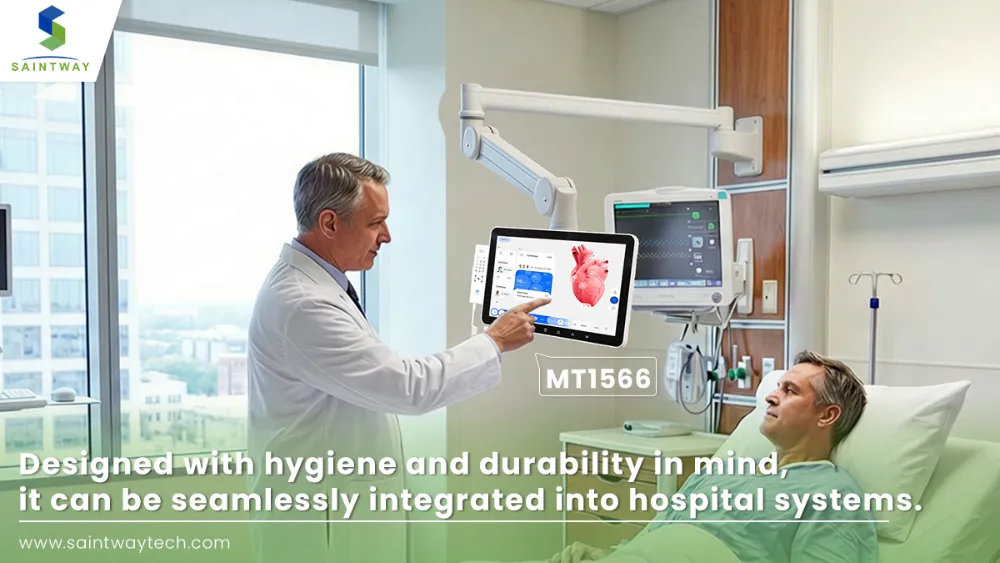
In a modern smart ward, the bedside terminal often acts as:
· A patient-facing interface for education, entertainment, communication
· A workflow endpoint for nurse call, service requests, acknowledgements
· A context-aware node linked to patient identity, bed assignment, and ward status
· A bridge between clinical systems and human interaction
Architecturally, this means the bedside terminal must:
· Integrate cleanly with multiple systems
· Support APIs and SDKs for custom workflows
· Remain operational across long hardware lifecycles
· Adapt to different ward designs, policies, and regions
This is not a UI challenge.
It is a system design challenge.
Designing Bedside Interaction for Real Workflows
Real wards do not operate in ideal conditions.
Nurses multitask.
Patients are stressed.
Families are unfamiliar with hospital systems.
Successful bedside interaction design prioritizes:
· Simplicity over features
· Workflow alignment over visual complexity
· Consistency across wards and facilities
When the bedside terminal aligns with how care is actually delivered—not how it is diagrammed—it becomes an enabler rather than a friction point.
Why This Matters for Integrators and Software Teams
For system integrators and healthcare software developers, the bedside terminal represents:
· The most visible part of the system
· The most sensitive to workflow failure
· The longest-living hardware component in the ward
Treating it as a core architectural layer allows teams to:
· Deploy new applications without reworking infrastructure
· Maintain compatibility across vendor ecosystems
· Scale solutions across hospitals and regions
In mature healthcare markets, this architectural thinking increasingly separates sustainable projects from short-lived pilots.
Conclusion: The Bedside Is Not the Edge—It Is the Center
Smart wards are not defined by dashboards or analytics platforms.
They are defined by what happens at the bedside, in real time, under pressure.
By elevating the bedside terminal to a core system layer, hospitals and technology partners can design smart ward environments that are resilient, scalable, and truly patient-centered.
The bedside terminal is not a peripheral device.
It is the architectural intersection of patient experience, clinical workflow, and digital infrastructure.
In smart wards, the bedside is where systems become care.
Latest Content
- Hospital Television Systems: 2026 Strategic Implementation Guide for Healthcare Facilities
- Ultimate Guide to Hospital Bedside Entertainment & Clinical Infotainment Systems
- Top Bedside Infotainment Terminal Manufacturers 2026: Reviews & Guide
- Transforming Patient Care With Smart Nurse Call Integration
- The Future is Now: Revolutionizing Patient Care with Bedside Infotainment Systems