
This article is Part 3 of the series “Designing the Smart Ward: A Practical Guide for Healthcare Integrators”, focused on helping system integrators and healthcare software teams design scalable, real-world smart ward environments.
Smart ward initiatives are often designed from a system or platform perspective. However, their success is rarely determined in backend architecture diagrams — it is determined at the bedside, where clinical workflows, patient interactions, and digital systems converge in real time.
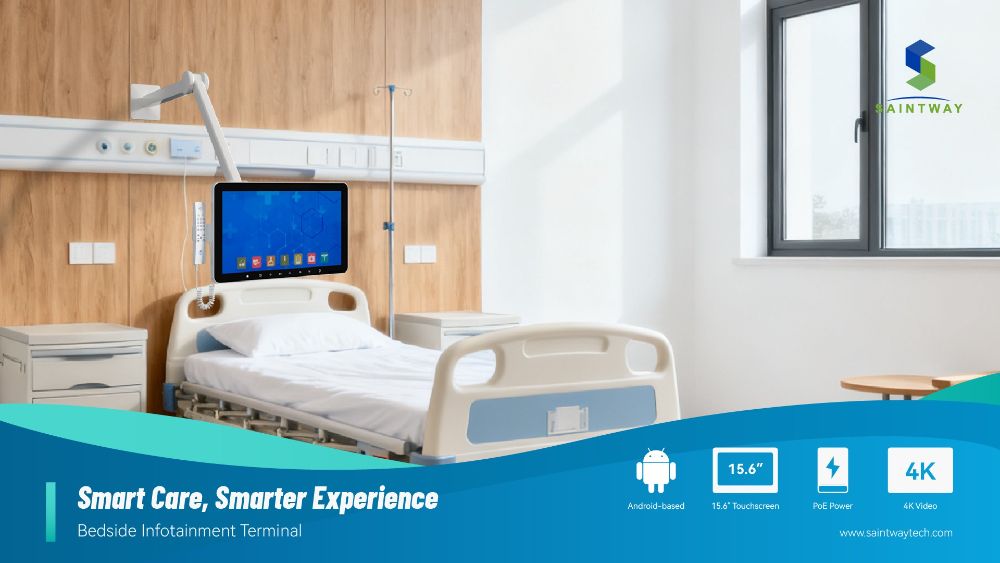
The bedside terminal is where smart ward design becomes operational. It is the point where nursing workflows meet patient needs, where system integration is tested under real pressure, and where poorly aligned designs are immediately exposed.
This article explores why workflow-centered thinking is essential in smart ward projects, and why understanding real ward environments — especially bedside interactions — is critical for healthcare software developers and system integrators building systems that actually work.
Why Workflow Comes First
Hospitals are not linear environments. Care delivery is shaped by interruptions, urgent priorities, staffing variability, and constant context switching. Any digital system that assumes ideal conditions will fail under real-world pressure.
Workflow—not hardware or software—should be the primary design input for smart ward systems.
The Gap Between Design and Reality
Many systems are designed from an IT or feature checklist perspective:
·Screens assume uninterrupted attention
·Interfaces expect complete data inputs
·Alerts assume immediate response
In reality:
·Nurses manage multiple patients simultaneously
·Tasks are frequently paused and resumed
·Information must be accessed quickly, often under stress
When systems ignore this reality, they increase cognitive load instead of reducing it.
Core Ward Workflows That Shape System Design
To design effectively, integrators and developers must understand three overlapping workflow layers:
Nursing workflows
Medication rounds, patient requests, documentation, coordination with physicians.
Clinical workflows
Orders, diagnostics, care plans, escalation paths.
Support workflows
Logistics, nutrition, housekeeping, equipment availability.
Smart ward systems sit at the intersection of these layers. Poorly designed integrations force staff to adapt their behavior to the system—rather than the system supporting care delivery.
Where Smart Ward Systems Commonly Fail
Across many projects, the same issues appear:
·Duplicate data entry across systems
·Delayed or missed alerts
·Fragmented patient information
·Interfaces that interrupt care instead of supporting it
These are not feature problems. They are workflow alignment problems.
Designing for the Real World
Workflow-centered systems acknowledge:
·Interruptions are normal
·Exceptions are common
·Simplicity beats completeness
·Speed and clarity matter more than visual richness
Designing for “edge cases” in hospitals often means designing for the most common situations.
Workflow-Centered Architecture Principles
Successful smart ward architectures typically share:
·Event-driven communication instead of rigid sequences
·Context-aware interfaces that adapt to role and situation
·Loose coupling between systems to avoid cascading failures
·Clear ownership of workflows across vendors and platforms
The Integrator’s Role
System integrators play a critical role as translators—bridging clinical reality and technical implementation. The most successful projects are led by teams who spend time understanding ward operations before defining system architecture.
From Features to Enablement
Hospitals increasingly evaluate solutions based on how well they:
·Reduce manual coordination
·Support staff under pressure
·Fit naturally into daily routines
The future of smart wards belongs to systems that enable care—not those that demand attention.
Final Thought
Most breakdowns in smart ward projects do not originate in core hospital systems — they surface at the bedside. This is where workflows intersect, where interruptions occur, and where digital tools either support care or create friction.
Designing workflow-centered hospital systems means designing for this reality. It requires treating the bedside terminal not as a simple interface, but as a critical system layer that reflects how care is actually delivered.
Smart wards succeed when systems adapt to clinical workflows — not when clinicians are forced to adapt to systems. And in that equation, the bedside remains the most honest measure of whether smart ward design truly works.
Latest Content
- Top Bedside Infotainment Terminal Manufacturers 2026: Reviews & Guide
- Identity & Security at the Bedside:Building Trust in Smart Ward Architectures
- Preparing Smart Wards for Hybrid Care and Long-Term Scalability
- Revolutionizing Patient Care: The Benefits of a Bedside Infotainment Terminal
- The Future is Now: Revolutionizing Patient Care with Bedside Infotainment Systems