
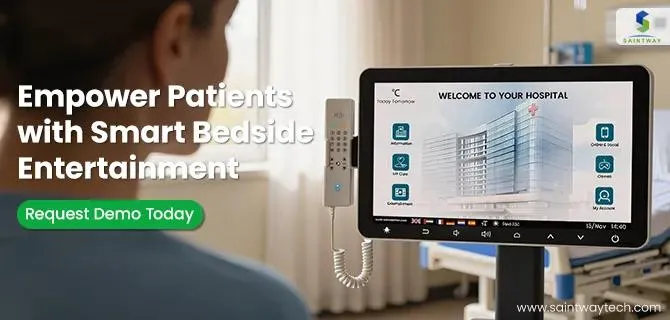
For the past decade, the “patient TV” was a ceiling-mounted relic—a source of frustration rather than care. Today, the paradigm has shifted. The hospital bedside infotainment system has evolved into the Interactive Patient Care System (IPCS) , functioning as the clinical, operational, and experiential hub of the modern smart hospital.
If you are evaluating a refresh of your patient room technology, you are likely navigating a landscape far more complex than hardware procurement. This guide provides a framework for selecting a system that doesn’t just entertain, but actively drives HCAHPS scores, reduces alarm fatigue, and delivers a measurable return on investment (ROI).
1. The Convergence of Clinical Workflow and Patient Experience
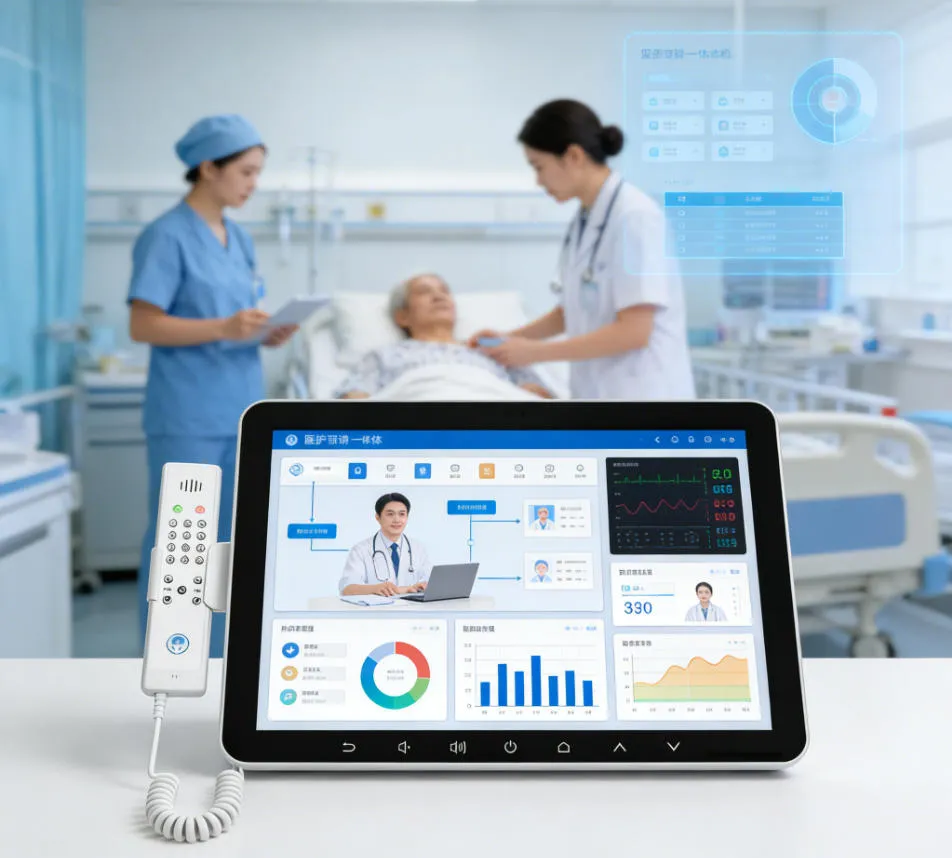
The most significant shift in the 2026 market is the death of the “infotainment-only” model. Legacy systems created silos: the TV was for leisure, the call light for nursing, and the tablet for education. Modern smart bedside terminals consolidate these functions into a single, secure endpoint.
The value proposition now rests on convergence:
- From Entertainment to Engagement: Patients expect the same digital autonomy they have at home. This includes voice-activated controls, personalized streaming, and bedside meal ordering. When a patient can order a kosher meal directly from a screen without waiting for a phone call, dietary satisfaction metrics improve by an estimated 18–22%.
- From Nurse Call to Predictive Workflows: The distinction between a nurse call button and a patient terminal is disappearing. Modern systems integrate directly with the EHR (Electronic Health Record) . A patient requesting pain management via the terminal logs that request directly into the clinical workflow, reducing cognitive load on nursing staff.

2. Technical Architecture: HL7, IoT, and the Zero-Touch Mandate
For a CTO or IT director, the “cool factor” of a touchscreen is irrelevant if it creates a cybersecurity vulnerability or an integration nightmare.
When evaluating vendors, the architecture must meet three non-negotiable standards:
A. HL7/FHIR Integration
The system must offer bidirectional communication with your EHR. This isn’t just about displaying patient education assigned by a physician; it is about closing the loop. If a patient watches a discharge video, that completion data should auto-populate in the EHR, signaling readiness for discharge coordination.
B. IoT Infrastructure
Smart beds, environmental controls (lights/shades), and location services should route through the bedside terminal. Look for solutions that offer wayfinding—helping long-term patients or visitors navigate large medical campuses directly from the in-room device.
C. Infection Control & Hardware
Gone are the days of rubberized, difficult-to-clean consumer tablets. In the post-COVID healthcare environment, hardware must meet IPX3 or higher water resistance standards and support UV-C light disinfection cycles. The best systems utilize antimicrobial glass and zero-pore surfaces that can withstand hospital-grade chemical wipes thousands of times without degradation.

3. The ROI Calculus: Beyond the Capital Expenditure
Hospital administrators often cite “cost” as the primary barrier to adoption. However, the modern business case for interactive patient care systems is built on three pillars of operational savings:
- Labor Efficiency: Automating non-clinical tasks (meal ordering, service requests, discharge instructions) reclaims nursing time. A 2025 study published in NEJM Catalyst noted that facilities with integrated bedside systems saved an average of 28 minutes per nurse per shift in non-clinical administrative tasks.
- Readmission Reduction: The highest risk period for a patient is the transition home. High-definition, interactive patient education delivered via the bedside terminal—rather than a static paper pamphlet—improves retention. Systems that offer “teach-back” functionality (quizzes to confirm understanding) are directly tied to reduced 30-day readmission penalties under value-based care models.
- Service Line Revenue: When patients have autonomy over their room environment (temperature, lighting) and entertainment, the perceived quality of care increases. This directly correlates to HCAHPS “willingness to recommend” scores, which influence Medicare reimbursement rates and market reputation.
4. The 2026 Vendor Selection Checklist
To ensure your investment remains relevant for the next 5–7 years, use the following checklist when evaluating vendors:
- API-First Architecture: Can the system integrate with your existing nurse call, EHR, and smart building systems without middleware that requires constant patches?
- Accessibility Compliance: Does the interface meet WCAG 2.1 AA standards? This is no longer optional. The system must support vision-impaired patients with text-to-speech and motor-impaired patients with voice control.
- Multilingual Support: With the diversity of patient populations, the interface must support real-time language translation, not just a static setting.
- Data Privacy: Ensure the platform is HIPAA-compliant out of the box. Patient-specific data should not reside on the device but on a secured server.
5. Future-Proofing: AI and Ambient Intelligence
As we look toward 2027 and beyond, the static “menu-based” terminal is evolving into an ambient intelligence platform.
The next generation of bedside infotainment leverages ambient listening. Instead of a patient pressing a button to order a blanket, the system’s AI (with patient consent) will analyze room conditions. If the room temperature drops below a comfort threshold and the patient is awake, the system may prompt: “I noticed it’s a bit cool. Would you like to adjust the thermostat or request a warm blanket?”
This shift from transactional (pressing for service) to predictive (anticipating needs) represents the ultimate goal of smart bedside technology: to make the technology invisible, allowing clinicians to focus solely on the patient.
Latest Content
- The 2026 Definitive Guide to Patient Bedside Entertainment Terminals
- Integrated Bedside Infotainment: 2026 Implementation & Security Guide
- How to Choose Smart Bedside Terminal: The Complete Hospital Buying Guide for 2026
- Smart Ward Trends 2026: How Advanced Hospitals Are Redefining Digital Care
- Touch-Based Bedside Interfaces: Redefining Patient Comfort Through Digital Experience