
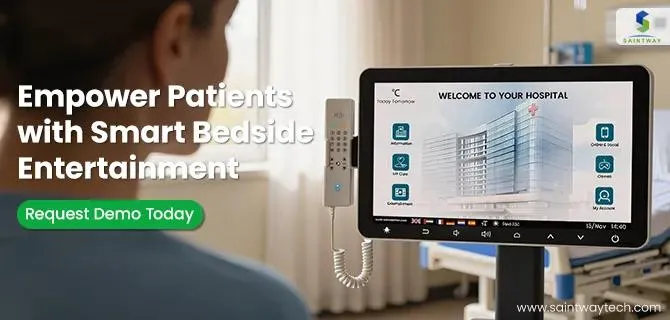
Introduction: The End of the Ceiling-Mounted TV Era
Walk into any hospital room built before 2020, and you will find the same scene: a small television mounted high on the wall, a clunky nurse call button dangling from a cord, paper menus on the bedside table, and a whiteboard with handwritten staff names that are perpetually out of date. This fragmented approach to patient room technology is no longer acceptable to modern healthcare consumers—and it is increasingly untenable for healthcare operations.
The patient bedside entertainment terminal has emerged as the unifying solution. What was once a simple entertainment device has evolved into a sophisticated interactive patient care system—a smart hospital bedside device that consolidates entertainment, clinical information, operational requests, and environmental controls into a single, intuitive interface.
For hospital administrators, chief information officers, nursing directors, and facility planners, the decision to deploy these systems represents a significant capital investment. But more importantly, it represents a strategic opportunity to improve patient satisfaction scores, streamline clinical workflows, reduce readmission rates, and position the organization for the next generation of value-based care reimbursement.
This guide provides a comprehensive framework for understanding, evaluating, and implementing patient bedside entertainment terminals. Drawing on the latest industry data, technical standards, and vendor capabilities, it addresses every aspect of the decision-making process—from feature specifications to integration requirements, from infection control to return on investment.
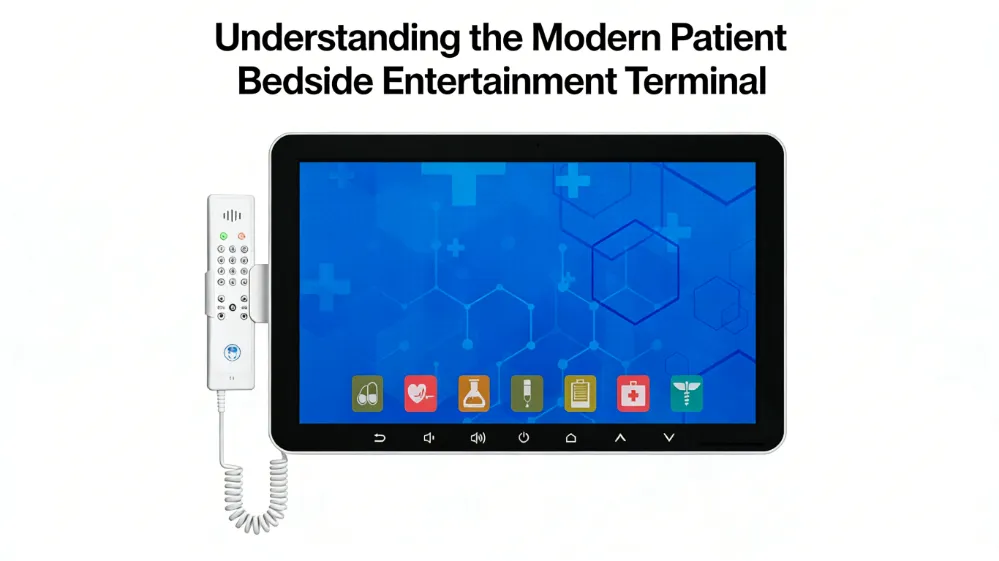
1. Understanding the Modern Patient Bedside Entertainment Terminal
1.1 What Is a Patient Bedside Entertainment Terminal?
A patient bedside entertainment terminal is a secure, mounted or articulating tablet-style device installed in hospital patient rooms that provides patients with access to entertainment content, clinical information, hospital services, and room controls through a single touchscreen interface.
The term “entertainment” in the name belies the device’s true functionality. While entertainment remains an important feature—patients expect access to streaming services, live television, movies, and music—the modern terminal functions as a comprehensive patient engagement platform that touches nearly every aspect of the hospital stay.
1.2 Key Features of 2026 Systems
Contemporary bedside terminals offer a feature set that extends far beyond traditional hospital televisions:
Entertainment Capabilities
- Streaming services (Netflix, Hulu, Amazon Prime, YouTube) integrated with personal account login capability
- Live cable and satellite television with channel guides
- On-demand movie and television libraries
- Music streaming and curated playlists
- Games and relaxation content
- Internet browsing with clinical content filtering
Clinical Functionality
- Digital whiteboards displaying care team names, roles, and schedules
- Medication schedules and reminders
- Patient education videos and materials assigned by clinicians
- Discharge instructions with teach-back assessments
- Pain scale reporting directly integrated with EHR
- Symptom tracking and reporting
Operational Services
- Meal ordering with dietary restriction filtering
- Housekeeping service requests
- Maintenance issue reporting
- Direct messaging to nursing staff
- Visitor check-in and management
- Patient satisfaction surveys
Environmental Controls
- Room temperature adjustment
- Lighting controls (overhead, reading, accent)
- Window shade and curtain controls
- Bed position adjustments (where integrated)
Accessibility Features
- Voice control for vision-impaired or mobility-limited patients
- Text-to-speech functionality
- High-contrast display modes
- Multiple language support including real-time translation
- Adjustable font sizes
1.3 Hardware Evolution: From Consumer Tablets to Medical-Grade Devices
Early adopters of bedside technology often attempted to use consumer-grade tablets mounted in patient rooms. This approach proved problematic. Consumer tablets lack the durability to withstand hospital environments, do not meet infection control requirements, and cannot integrate securely with clinical systems.
Modern hospital bedside tablets are purpose-built medical devices. They feature:
Medical-Grade Enclosures
- Antimicrobial housing materials that inhibit bacterial growth
- Sealed, zero-pore surfaces that withstand repeated chemical disinfection
- UV-C disinfection compatibility for automated cleaning cycles
- IPX3 or higher water resistance ratings for splash protection
Industrial Durability
- Drop and impact resistance for high-use environments
- No moving parts to fail or trap contaminants
- Fanless designs that prevent airborne particle circulation
Clinical-Grade Connectivity
- Built-in proximity sensors for automatic wake and sleep
- RFID and NFC capability for staff authentication
- Dual-band Wi-Fi 6E or Wi-Fi 7 connectivity
- Bluetooth for peripheral device pairing
2. The Technology Stack: Integration Requirements for IT Leaders
For chief information officers and IT directors, the patient bedside entertainment terminal is not a standalone device—it is a node in a complex clinical and operational technology ecosystem. Successful deployment requires robust integration with existing hospital systems.
2.1 EHR Integration
The most critical integration is with the Electronic Health Record (EHR) . Bidirectional communication between the bedside terminal and the EHR enables:
- Patient identification and authentication at login
- Display of assigned care team members
- Presentation of prescribed patient education materials
- Documentation of patient-reported outcomes (pain scores, symptoms)
- Completion tracking for discharge readiness
- Medication schedule display and acknowledgment
Integration typically occurs through HL7 messaging protocols or modern FHIR (Fast Healthcare Interoperability Resources) APIs. The most sophisticated systems offer two-way synchronization—when a patient completes a discharge video on the bedside terminal, that completion status is automatically recorded in the EHR, triggering discharge workflow notifications.
2.2 Nurse Call System Integration
Traditional nurse call systems operate on separate infrastructure from bedside technology. Leading bedside terminals integrate directly with existing nurse call systems, allowing patients to:
- Request nursing assistance through the touchscreen interface
- Specify the type of assistance needed (pain medication, bathroom assistance, water refill)
- Receive estimated response times
- Cancel requests when no longer needed
This integration reduces alarm fatigue by categorizing and prioritizing requests, and provides nursing leadership with data on response times and request patterns.
2.3 Smart Room Technology
The modern smart hospital leverages IoT (Internet of Things) in healthcare to create responsive environments. Bedside terminals serve as the control interface for smart room systems, enabling patients to:
- Adjust lighting presets (reading, examination, sleep)
- Control room temperature
- Operate window shades
- Manage television and audio settings
Advanced implementations use occupancy sensors and machine learning to anticipate patient needs. For example, if room temperature drops below a comfortable threshold during nighttime hours, the system may automatically adjust heating without requiring patient intervention.
2.4 Service Management Platforms
Behind the scenes, bedside terminals connect to hospital service management platforms that route patient requests to appropriate departments:
- Meal orders go to dietary services with specific dietary restriction flags
- Housekeeping requests generate work orders with location details
- Maintenance reports create tickets in facility management systems
This integration provides operational analytics on response times, service volumes, and patient satisfaction by service category.
2.5 Security and Compliance
Healthcare IT leaders must ensure that bedside terminal deployments meet rigorous security standards:
- HIPAA compliance requires that all patient data be encrypted in transit and at rest
- User authentication must prevent unauthorized access to patient information
- Session timeouts should protect unattended terminals
- Audit logs must track access to patient data
- Network segmentation should isolate bedside terminals from critical clinical systems
The most secure systems store no patient data locally on the device. All sensitive information resides on hospital servers, and the bedside terminal functions as a secure display and input device.
3. Clinical Impact: Beyond Patient Satisfaction
While patient entertainment systems are often justified through patient experience metrics, their clinical impact extends far deeper.
3.1 Impact on HCAHPS Scores
The HCAHPS (Hospital Consumer Assessment of Healthcare Providers and Systems) survey measures patient perspectives on hospital care. Several HCAHPS domains are directly influenced by bedside terminal functionality:
- Communication about medications: Terminals display medication schedules and provide patient education
- Responsiveness of hospital staff: Integrated nurse messaging provides transparency on response times
- Quietness of hospital environment: Environmental controls reduce patient-initiated calls for room adjustments
- Discharge information: Digital discharge instructions with teach-back improve comprehension
Healthcare organizations that have implemented comprehensive interactive patient systems report HCAHPS score improvements ranging from 5 to 15 percentile points across relevant domains.
3.2 Patient Engagement and Health Literacy
Patient engagement—the extent to which patients take an active role in their care—correlates strongly with clinical outcomes. Bedside terminals facilitate engagement by:
- Delivering patient education in multiple formats (video, text, interactive)
- Using teach-back methodologies that confirm understanding before discharge
- Providing medication schedules that patients can acknowledge
- Enabling patients to report symptoms and concerns in real time
A 2025 study published in the Journal of Medical Internet Research found that patients using interactive bedside systems demonstrated 34% higher medication adherence post-discharge compared to patients receiving standard education materials.
3.3 Nursing Efficiency and Satisfaction
Nurse burnout is one of healthcare’s most pressing challenges. Bedside terminals reduce nursing workload by:
- Eliminating non-clinical interruptions (meal order calls, maintenance requests)
- Providing digital whiteboards that prevent repetitive “who is my nurse today” questions
- Enabling remote patient status checks
- Reducing time spent on discharge instruction delivery
Facilities with integrated bedside systems report saving an average of 25 to 35 minutes per nurse per shift in non-clinical tasks. This reclaimed time translates to more direct patient care and reduced overtime costs.
3.4 Readmission Reduction
Hospital readmissions carry financial penalties under value-based care models. The discharge process is a critical intervention point, and bedside terminals enhance discharge effectiveness by:
- Delivering discharge instructions when patients are most receptive
- Using video and interactive formats that improve comprehension
- Confirming understanding through teach-back questions
- Providing post-discharge follow-up resources
Organizations using bedside terminals for discharge education have documented 30-day readmission reductions of 12% to 18% among targeted patient populations.
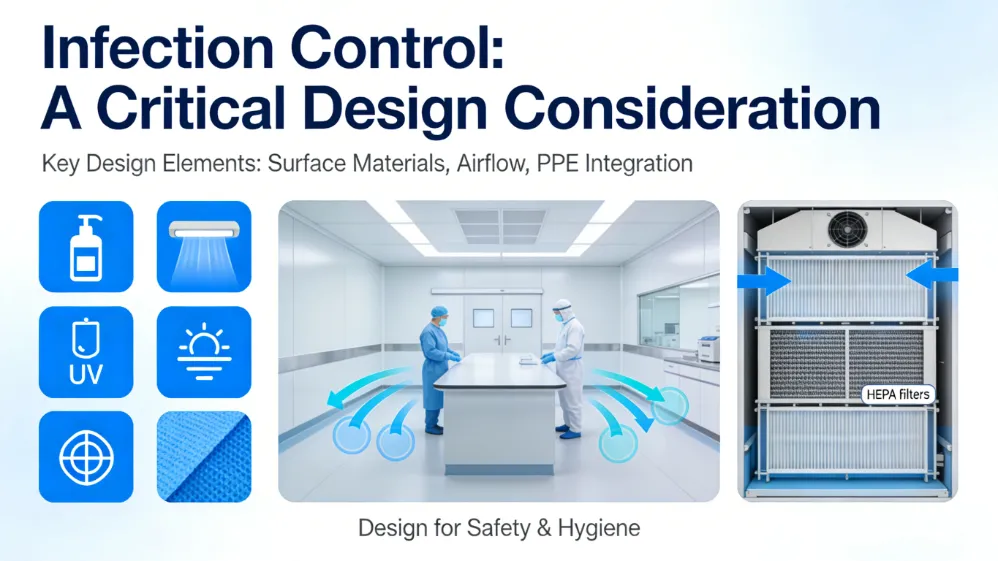
4. Infection Control: A Critical Design Consideration
Hospital-acquired infections remain a persistent challenge, and any device placed in patient rooms must meet rigorous infection control standards.
4.1 Material Science
Medical-grade bedside terminals use materials specifically selected for healthcare environments:
- Antimicrobial copper alloys or silver-ion impregnated plastics inhibit bacterial growth
- Sealed enclosures with no crevices or seams that trap contaminants
- Smooth, non-porous surfaces that withstand aggressive cleaning protocols
4.2 Disinfection Compatibility
Hospital environmental services teams use powerful chemical disinfectants to clean patient rooms. Bedside terminals must withstand:
- Quaternary ammonium compounds
- Hydrogen peroxide-based cleaners
- Bleach solutions (sodium hypochlorite)
The most durable terminals are tested to withstand tens of thousands of cleaning cycles without material degradation.
4.3 UV-C Compatibility
UV-C disinfection using ultraviolet light has become standard in many healthcare facilities. Devices that are UV-C compatible can be safely exposed to germicidal ultraviolet light without damage to displays, sensors, or internal components.
Facilities with UV-C disinfection programs should verify that bedside terminals are certified for UV-C exposure and do not require covering or removal during disinfection cycles.
4.4 Touchless Interaction
The COVID-19 pandemic accelerated interest in touchless technology. While touch remains the primary interaction method for most patients, modern terminals increasingly offer:
- Voice control for core functions
- Proximity sensors that wake displays without touching
- Gesture recognition for simple commands
These features allow patients who are immunocompromised or in isolation to interact with the system without touching shared surfaces.
5. The ROI Calculus: Building the Business Case
Hospital finance leaders require clear return on investment projections for technology investments. The business case for patient bedside entertainment terminals rests on multiple revenue and cost drivers.
5.1 Revenue Enhancement
HCAHPS and Reimbursement
Under the Hospital Value-Based Purchasing program, Medicare reimbursements are adjusted based on HCAHPS performance. The top-performing quartile of hospitals receive payment bonuses, while low performers face penalties. A 1-point improvement in overall HCAHPS scores can translate to millions in reimbursement impact for large health systems.
Patient Volume and Market Share
Patient satisfaction scores influence patient choice, particularly for elective procedures and services. Organizations with superior patient experience ratings capture market share from competitors.
Service Line Utilization
Bedside terminals promote hospital services through digital menus and educational content, potentially increasing utilization of ancillary services.
5.2 Cost Reduction
Labor Efficiency
The most significant cost savings come from nursing and operational efficiency. Reclaiming 30 minutes per nurse per shift across a 200-bed facility with 3 shifts reduces annual nursing labor costs by hundreds of thousands of dollars.
Readmission Penalties
Avoiding a single readmission saves $10,000 to $20,000 in direct costs plus avoids Medicare penalties that can reach 3% of total Medicare payments.
Food and Service Waste
Digital meal ordering with dietary restriction filtering reduces food waste by ensuring patients receive appropriate meals the first time.
Paper Reduction
Digital whiteboards, menus, and education materials eliminate printing and distribution costs.
5.3 Typical Implementation Costs
Total costs vary based on facility size, room count, and integration requirements. Typical cost components include:
- Hardware per terminal: $1,500 to $3,500
- Software licensing: $30 to $60 per bed per month
- Installation and mounting: $200 to $500 per room
- Integration and project management: 15% to 25% of hardware cost
For a 200-bed facility, total implementation costs typically range from $400,000 to $800,000, with ongoing annual operating costs of $70,000 to $150,000.
5.4 ROI Timeline
Organizations that successfully implement bedside terminal programs typically achieve:
- Year 1: Initial operational efficiency gains, early HCAHPS improvements
- Year 2: Full labor savings realized, readmission reductions measurable
- Year 3: Complete ROI achieved with ongoing positive returns
The payback period for well-executed implementations ranges from 18 to 36 months, with five-year returns ranging from 200% to 400% of initial investment.
6. Vendor Selection: The 2026 Evaluation Framework
Choosing the right vendor is the most critical decision in a bedside terminal implementation. The following framework provides a structured approach to vendor evaluation.
6.1 Technical Evaluation Criteria
| Category | Evaluation Questions |
|---|---|
| EHR Integration | Does the vendor offer pre-built integrations with major EHR platforms (Epic, Cerner, Meditech)? What APIs are available for custom integration? |
| Nurse Call Integration | Which nurse call systems are supported? Does integration require middleware? |
| Security | Is the platform HIPAA compliant out of the box? What security certifications are maintained (HITRUST, SOC 2)? |
| Hardware Durability | What cleaning protocols are the devices tested against? Are they UV-C disinfection compatible? What warranty coverage is provided? |
| Software Architecture | Is the platform cloud-hosted or on-premise? What uptime guarantees are offered? |
6.2 Functional Evaluation Criteria
| Category | Evaluation Questions |
|---|---|
| Patient Experience | Is the interface intuitive for elderly and tech-savvy patients alike? Are voice control and accessibility features comprehensive? |
| Clinical Content | Is patient education content provided, and is it evidence-based? Can clinical teams create custom content? |
| Reporting | What analytics are available for usage, satisfaction, and operational metrics? |
| Service Management | How are patient requests routed? What dashboards are available for department managers? |
6.3 Implementation and Support
- Implementation methodology: Does the vendor have a proven implementation process? What is the typical timeline?
- Training: What training is provided for nursing staff, IT teams, and service departments?
- Support: What are support hours and response times? Is technical support based in the same region?
- Upgrades: How are software updates delivered? Are upgrades disruptive?
6.4 Leading Vendors
The 2026 market includes several established vendors with distinct approaches:
- BEWELL: Focus on integrated clinical workflows and EHR synchronization
- Sonifi Health: Strong in entertainment content management and hospitality services
- Lincor Solutions: Specializes in patient engagement and bedside documentation
- Advantech: Medical-grade hardware with flexible software options
- GetWellNetwork: Comprehensive patient engagement platform with strong clinical outcomes focus
Each vendor should be evaluated based on specific organizational priorities and existing technology infrastructure.
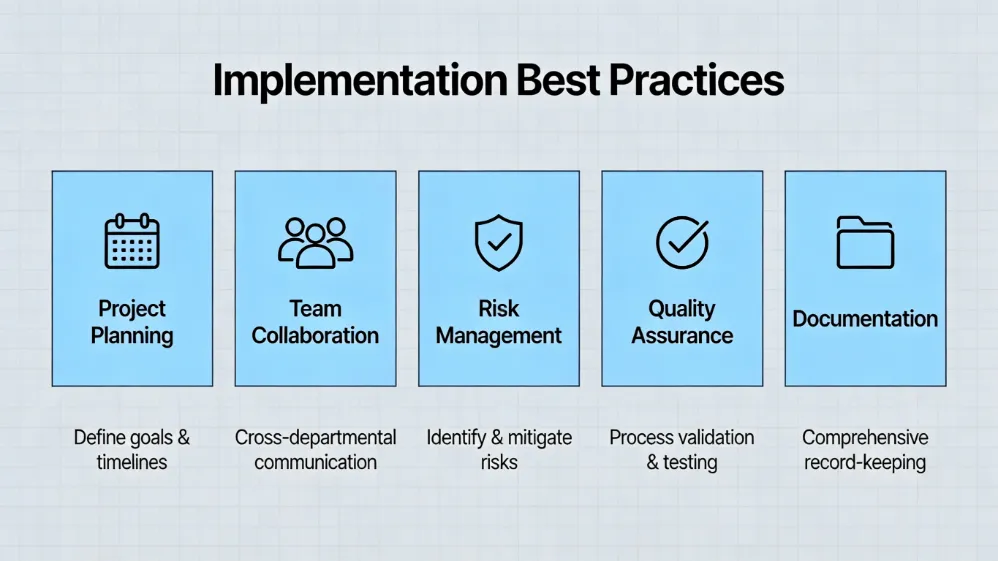
7. Implementation Best Practices
Successful implementation requires careful planning and change management.
7.1 Stakeholder Engagement
Engage all affected departments early in the planning process:
- Nursing leadership: Involve nurse managers in feature selection and workflow design
- IT and informatics: Ensure integration requirements are fully scoped
- Facilities: Plan for mounting, power, and network requirements
- Dietary and environmental services: Prepare these departments for new service request workflows
7.2 Phased Rollout Approach
A phased rollout reduces risk and allows for iterative improvement:
- Phase 1: Pilot Unit: Deploy on one nursing unit for 60 to 90 days
- Phase 2: Evaluation: Gather feedback, refine workflows, address technical issues
- Phase 3: Expansion: Roll out to additional units in waves
- Phase 4: Optimization: Use analytics to refine content and workflows
7.3 Training and Change Management
- Provide hands-on training for nursing staff on integration workflows
- Prepare service departments for new request channels
- Develop patient-facing materials explaining the new technology
- Designate unit-based champions to support adoption
7.4 Success Metrics
Establish clear success metrics before implementation:
- HCAHPS scores by domain
- Nurse time spent on non-clinical tasks
- Patient request response times
- Patient education completion rates
- Readmission rates for targeted populations
- Service department efficiency metrics
8. Future Trends: Where Bedside Technology Is Headed
The patient bedside entertainment terminal is an evolving technology. Several trends will shape its development over the next five years.
8.1 Ambient Intelligence
The next generation of bedside systems will shift from transactional to predictive interactions. Using sensors and machine learning, systems will anticipate patient needs rather than waiting for requests:
- Detecting sleep patterns to optimize room environment
- Recognizing mobility limitations to prompt assistance
- Analyzing speech patterns to flag potential clinical deterioration
8.2 Generative AI Integration
Large language models will enable more natural conversational interfaces. Patients will be able to ask questions about their care plan, medication, or schedule and receive personalized, clinically appropriate responses.
8.3 Remote Patient Monitoring Integration
As care shifts from hospital to home, bedside terminals will serve as the inpatient endpoint for remote patient monitoring programs, ensuring continuity between inpatient and post-discharge care.
8.4 Extended Reality
Virtual and augmented reality applications are emerging for pain management, cognitive therapy, and patient education. Future terminals may incorporate or interface with extended reality devices.
8.5 Zero-Touch Interfaces
Advanced voice recognition, gesture control, and computer vision will reduce or eliminate the need for physical touch, addressing both infection control concerns and accessibility requirements.
Conclusion: Making the Decision
The decision to deploy patient bedside entertainment terminals is not merely a technology upgrade—it is an investment in patient experience, clinical outcomes, and operational efficiency. The systems available today bear little resemblance to the ceiling-mounted televisions of the past. They are sophisticated platforms that sit at the intersection of clinical care, patient engagement, and smart hospital infrastructure.
For organizations ready to make this investment, the path forward involves:
- Assessing current state: Evaluate existing patient room technology and its limitations
- Defining requirements: Prioritize features based on organizational goals and patient population
- Developing the business case: Quantify expected ROI based on labor savings, HCAHPS improvements, and readmission reductions
- Selecting the right partner: Choose a vendor with proven integration capabilities and a clear product roadmap
- Planning for implementation: Engage stakeholders, pilot on one unit, and expand thoughtfully
The healthcare organizations that will thrive in the coming decade are those that embrace the digital transformation of the patient room. The patient bedside entertainment terminal is not just a screen—it is the gateway to a more responsive, efficient, and human-centered healthcare experience.
References and Resources
- Centers for Medicare & Medicaid Services. Hospital Value-Based Purchasing Program. 2025.
- Journal of Medical Internet Research. “Impact of Interactive Patient Systems on Medication Adherence.” 2025.
- NEJM Catalyst. “Technology and the Future of Patient Engagement.” 2024.
- The Joint Commission. “Health Care Equipment Safety Standards.” 2025.
- Healthcare Information and Management Systems Society (HIMSS). “Smart Hospital Maturity Model.” 2026.
Latest Content
- Beyond the Screen: The 2026 Playbook for Smart Bedside Infotainment Systems
- Integrated Bedside Infotainment: 2026 Implementation & Security Guide
- How to Choose Smart Bedside Terminal: The Complete Hospital Buying Guide for 2026
- The Future is Now: Revolutionizing Patient Care with Bedside Infotainment Systems
- Identity & Security at the Bedside:Building Trust in Smart Ward Architectures